Showing posts with label Fantasy. Show all posts

Wednesday, 2 January 2019

Mesmerized


The evolution of Merlin and of Ygraine and Uther, the parents of the Once and Future King, re-imagined through a unique blend of mythology, science fiction and ancient history. 

I got to looking forward to the next installment, for the aesthetic rush of your performance that invariably left me feeling uplifted, strengthened. Somehow – magically! – your artistic élan brightened my own mundane history. That’s the authentic power of art! Thank you for bringing that power to my novel.
I am mesmerized by the voice you have given this novel

 A. A. Attanasio describing
Pippa Rathborne's
narration of
THE DRAGON AND THE UNICORN

Wednesday, 15 March 2017

Monogamy wars

http://www.audible.co.uk/pd/Fiction/Lady-Whiltons-Wedding-Audiobook/B06XJ9QWX9

The darker the times, the lighter the entertainments.

LADY WHILTON'S WEDDING
by Barbara Metzger, read by Pippa Rathborne

available on Amazon, Audible and iTunes

https://pipparathborneactress.wordpress.com/2017/03/15/a-battle-for-monogamy/
Portrait of Lieutenant General the Hon. Sir Charles Stewart, K.B., in hussar uniform by Sir Thomas Lawrence.
The 1814 'Londonderry' version of Lawrence's portrait of the future 3rd Marquess of Londonderry, wearing the medal he was awarded for service as a commander in the Peninsular War.
Lawrence was the visual propagandist of Regency romance and glamour. He gave all his sitters the gloss of celebrity makeovers, and made every portrait look like a love affair in paint. Image: Wikipedia

Wednesday, 21 October 2015

"A life larger than the sentence" (2)

https://pipparathborne.wordpress.com/2015/10/21/a-life-larger-than-the-sentence/

 Flight into High Fantasy:

The audiobook of THE DRAGON AND THE UNICORN by A.A. Attanasio, read by Pippa Rathborne,
is available on Amazon, Audible and iTunes.

If you would like a complimentary copy, please contact me by email or leave a message on the comment section of Pippa Rathborne's blog by clicking here and I will be delighted to send you a promo code.

Tuesday, 18 November 2014

Romantic Fictions and Casualties

Part Four:
The Prophetess and the Muse

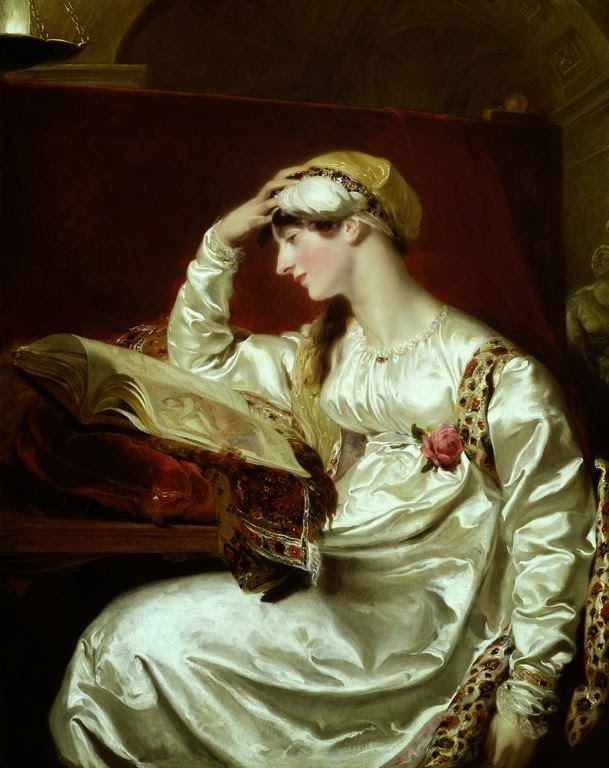
Shortly after the death of the eldest daughter of The Tragic Muse, whom he had once thought he loved, in the same year of 1803, the artist found his ideal of physical and intellectual femininity personified in an elegant and composed woman, a refined and independent spirit who understood his temperament and his art. She was about the same age as the daughter of tragedy, perhaps a few years older, tall and dark like her, but uncomplicated by illness and sisters.

She was a model of discretion as much as beauty, a social sophisticate who made no demands on him. She did not need marriage to consummate their friendship so not a breath of scandal marred the artist's reputation ever again. Her gratification came from inspiring and guiding him to create works that would invest her with immortality by association. She was his perfect muse.

The shining culmination of the artist's love of his muse:
Sir Thomas Lawrence. Mrs. Jens Wolff, 1803 - 1815. 
© The Art Institute of Chicago, Mr. and Mrs. W. W. Kimball Collection.
At the time she first met Lawrence, Isabella Anne Hutchinson was unhappily married to the Danish diplomat and art collector Jens Wolff from whom she later separated in 1810.

He spent twelve years painting her portrait, and it was the most emotionally tender image of a woman he ever created.

The éclat of her splendid aquiline profile, gracefully bent in contemplation of Michelangelo's drawings, recalled the artlessly drooping head of the dead girl he had tried to love, listening to her own thoughts, composing her own songs. If he had been a woman, this was how he would like to have been painted, and loved.


The Tragic Muse carried on working for a few more years after her eldest daughter's death, but she had lost some of her elemental power. The people no longer worshipped as before. They demanded to see her in the same parts, then criticized her for using “her great guns” too soon, never caring that the goddess in person really was "in paroxysms of agony".[1]

Her presence had always been monumental, but now her body had grown so heavy that could not get up without help during performances. People felt sorrier for the woman herself than the characters she was playing.

William Blake,Hecate or the Three Fates c. 1795. Tate Gallery, London. 
Image source: WGA

Despite her habit of standing outside herself, so she could control the effect she was making, mortality had overrun her divine gift. Either her own emotions had burst their banks and flooded the character she was imagining, or public taste in deities was changing....

Friday, 14 November 2014

Romantic fictions and casualties

PART THREE: SILENCE

 Silence by Fuseli, 1799-1801
Oil on canvas, Kunsthaus, Zurich. Image source: WGA

The lightning struck, and receded, the earth quaked and settled again. Resolute, she never spoke again of love and betrayal. She began to believe that the artist had never loved her for her own sake, but more for the sensation of passion, a drama of love, in which she and her sister had been no more to him than sparks of her mother's fire. She knew her mother and he still met, an ageing goddess and her acolyte, and she did not say a word of reproach to either of them.

But the worm had entered the bud. During the next five years, while his fame as an artist and a lover spread, and queens and princes were seduced by him, and still he wore his sweet-sad smile, she started to wither away until her own muse fled - “I sing but little now to what I did once”. She had lived only to give joy to those she loved, and she had no joy left. She had reached the limits of feeling. She lived, but it was the posthumous existence of despair.
Every asthma attack was like a drowning, in which to die would be easier than the struggle for breath. She yielded to invalidism as if it was a lover. 

She never lost faith in her mother, she would always be the chief priestess of the Tragic Muse, ensuring nothing distracted the goddess, knowing that the slightest shift of wind might upset the sacred artifice of her art, causing the goddess to misjudge her timing or overreach her power to represent emotion from feeling too much, performing worst when she most ardently wished to do better than ever.[1]

Her breath got shorter and shorter. Even when she knew she was dying, the eldest daughter did not want to cause her mother trouble. There was never any question that the goddess must continue working while her daughter was ill, often travelling far away, giving spiritual sustenance to her worshippers on other islands to pay for medicine, food, clothing and lodgings for her family.  All her life the girl had suffered in her mother's absence which created a vacancy in her heart that nothing else could fill [2] but she and her father, a mere mortal player, not a god, who relied on his wife's earnings to maintain their household, kept the worst news to themselves.


Drawing of Sarah Siddons, artist and date unknown  © Victoria and Albert Museum 
 

At last there came a day when an attendant dared tell the Tragic Muse that her daughter was dying. "Will you believe I must play tonight!" [3] exclaimed the distraught mother. She had always known that she was not immortal, as people wanted her to be, but rather an heroic victim of her own powers of arousing emotion. She broke her contract so she could rush home, but her journey across the sea was delayed by great storms, which neither her dramatic arts nor maternal appeals could appease, and when she arrived, her lovely child, her sweet Sally, was already dead.


Claude-Joseph Vernet, Nocturnal Seastorm 1752
Oil on canvas. Private collection. Image source WGA


[1] Paraphrasing Sarah Siddons' much quoted piece of self-criticism that holds true for all actors, from her letter to Rev. Whalley, 16 July, 1781, published in The Kembles, Percy Fitzgerald, 1871: "Sorry am I to say, that I have often observed I have performed worst when I have most ardently wished to do better than ever"[2] Paraphrasing Letter from Sally Siddons to Miss Bird, 15 September, 1798, quoted by F.M.W. Parsons, The Incomparable Siddons, 1909, p.199.
[3] Paraphrasing Letter from Mrs Siddons to Mrs Fitzhugh, quoted by Parsons, p.204

Saturday, 8 November 2014

Romantic fictions and casualties

PART TWO: The temple of delight

 
Fragonard, The Fountain of Love 1785. Oil on canvas, Wallace Collection, London.
Image source: WGA. In this painting, the purveyor of insouciance and erotica for the ancien regime breaks into the psychological dreamworld of the Neoclassicists and Romantics.
"I fly with HORROR from such a passion" Sally Siddons

The Tragic Muse's eldest daughter had loved the artist steadfastly even after he had forsaken her for her younger sister, a pretty, airheaded girl of sixteen he decided, on an impulse, to marry. 

During this gaping wound in time, her two years of "mortification, grief, agony", a new kindling began inside her. Under layers of suffering, she heard more clearly the music of her calling. 

Passion reverberated in her, enriching her voice with sweetness, her melodies with mortal yearning: “I never should have sung as I do had I never seen you; I never should have composed at all. . . You then liv'd in my heart, in my head, in every idea…”. 

She had turned a fallible man into her muse, and given birth to her own art.

Saturday, 1 November 2014

Romantic fictions and casualties

“I never should have sung as I do had I never seen you; I never should have composed at all. . . You then liv'd in my heart, in my head, in every idea…” 

 
The Art of Loving or The Pleasant Lesson, furnishing fabric,
Favre Petitpierre et Cie (possibly, maker), ca.1785-1790, detail © Victoria and Albert Museum, London

PART ONE
One autumn long ago, while Britain was at war with revolutionary France, whose armies under Napoleon had conquered most of mainland Europe, and the people at home were rejoicing at Nelson's victory at the Battle of the Nile that saved the Middle East, while Irish rebels were fighting their English oppressors with the help of the French; while Jenner's findings on vaccination against the mass killer small-pox were being published; while a new kind of poetry was being read for the first time in Coleridge and Wordsworth's collection of Lyrical Ballads, while quietly in a village in Hampshire Jane Austen was writing Northanger Abbey, and a new kind of woman appeared in a novel called Maria: or, The Wrongs of Woman by Mary Wollstonecraft; while the external world was spinning and bleeding and crying and laughing, the eldest daughter of the Tragic Muse renounced forever the man she loved. 

He was a charming young artist who painted everyone as if he was in love with them. His pencil, chalk and brush had the power of Cupid's arrows to pierce men and women with the flushed, breathless heat of desire. When he looked at someone, however dull they had felt the moment before, they saw the reflection of beauty in his eyes. 


François-André Vincent, Zeuxis Choosing his Models for the Image of Helen from among the Girls of Croton 1789. 
Oil on canvas. Private collection. Image source: WGA

He was....

Monday, 31 March 2014

End of the fairy tale

 PART SIX of THEATRES OF POWER 1580-1780

There was a torture chamber hidden under the fairytale palaces, the vanishing flower-garlanded places where laughing, well-fed putti eternally play after the people, surfeited on Rococo, have died or fled.

Apollo with the Graces and Muses painted for the ceiling of the Théâtre de la reine, at Trianon,
 Versailles, by Jean-Jacques Lagrenée, 1779. Image source: Wikipedia


The restrained imagery of the later Stuart monarchy reflected the bloodless 1688 revolution in political realities. Baroque was sobered down, mannered. Its architecture was perceived as heavy and florid, and was already going out of fashion by the time its last great palace, Blenheim, was finished in 1716, to complaints from the owner, Sarah, Duchess of Marlborough, about the impracticalities of the design. The architect, John Vanbrugh, whose other most famous building is the fairy tale Castle Howard, a fantastical stage set on the Yorkshire moors, was....

Monday, 10 March 2014

Wedding of the Gods

 PART FOUR of THEATRES OF POWER

Stefano della Bella (1610-1664) Scene Five, "Hell", of a set of stage designs 
for Le Nozze degli Dei, 1637. 
Image copyright The Samuel Courtauld Trust, The Courtauld Gallery, London

The origins of the theatrical spectaculars of the Baroque and our own time, and of classical ballet and opera, are usually traced by academics to the "magnifences" of Catherine de Medici, who, out of dire political necessity during the Wars of Religion, built on two traditions, the Valois court entertainments and the intermezzi of her own family’s court in Florence, to devise cultural showcases for dynastic policies. 
Dynasty: Catherine de Medici and her husband, Henri II, at the centre of family satellites 
in France and other European states. 
Miniatures by Clouet. Image source: WGA

Two engravings by Jacques Callot in the Courtauld exhibition gave an idea of the ambitious scale of the entertainments laid on by the Medici, including a mock water battle to celebrate the visit of the Prince of Urbino in 1619, which was watched by 30,000 people. In modern terms, these huge events were the equivalent of staging the opening ceremony of the Olympic Games, and the intermezzi are comparable to.....

Friday, 28 February 2014

Enchanted Islands

PART THREE of THEATRES OF POWER
 
As proof that Louis XIV’s power was absolute, Nature itself was subservient to him in the water gardens of Versailles. The fountain jets of le bosquet du théâtre d’eau (replaced in the early 1770s by a plain grass covered grove, and recently excavated) were designed, according to the fontaineer Claude Denis, to perform “obeisance to the king of kings”.

 Le théâtre d’eau - vue de la scène, 
one of the views of les bosquets, or groves, of Versailles by Jean Cotelle the younger, 1693. 
Image source: Wikipedia

For over a hundred years, the official pretexts for the exquisite staged illusions in the chateau's grounds were usually celebrations of royal weddings and new-born heirs, as you would expect of a fairy tale, but also, on occasion, the birth of a son to the king's favourite mistress of the moment, and the acquisition of territories through war, ruinously expensive in money and lives. "I have loved war too much", confessed the dying king, forty years later, when he bequeathed toxic, bankrupt splendour to his five year old heir. 

Feu d'artifice: Firework display on the canal at Versailles, one of the divertissements held at Versailles to celebrate the reconquest of Franche-Comté in 1674. On previous days of the festival, Lully's ballet Alceste had been performed in front of the Marble Court and Moliere's Le Malade Imaginaire in front of the Grotto of Thetis. Engraving by Le Pautre, 1676. 
Image © RMN, Musée du Louvre/Photo Thierry de Mage

Advanced technology and artistic talent mythologized life at court, enabling the refulgent monarchy to divert the nobility into acquiescence during peacetime, and dazzle friends and enemies abroad, with ballets, plays, operas, tricks of the eye, dancing fountains, musical gardens and artificial fire. The population excluded from wealth and political power, the artisans and peasants, were invited to marvel at the pleasures of the elite from a safe distance, on the terrace behind the palace or in the branches of the garden trees.

Louis XIV had always intended Versailles should be a theatre...

Wednesday, 19 February 2014

Theatres of Power

PART TWO
 It was not the artist's fault that the real king rode into the picture of himself and never came out.
 
Charles I with M. de St Antoine by Van Dyck, 1633, Royal Collection. 
Image source: Wikimedia Commons

Baroque imagery, even when superbly executed by artistic geniuses, did not always succeed as political message in the patron's favour or keep the King or Queen's head on during a revolution, but it still works as art. Over three and a half centuries later, the first impression of Charles I that grabs most of us is Van Dyck's interpretation of a refined and chivalric paternalistic figure, not "that man of blood", the "tyrant, traitor, murderer and public enemy to the good of this nation" called to account for all the lives that had been lost in civil war.
 
Van Dyck's portraits, etherealising Charles I and his court, are as much of a theatrical device as Inigo Jones' fantastical masque designs, creating an ineradicable illusion of aristocratic grace and virtue in parallel with the historic reality of an unpopular and flawed regime. It was not the artist's fault that the real king walked into the picture and never came out. A sophisticated public relations initiative presented Stuart hereditary monarchy as an ideal nuclear family, affectionate and impeccably dressed, complete with pet dog and aspirational home.....

Wednesday, 12 February 2014

The tyranny of fantasy

THEATRES OF POWER 1580-1780
Part One

You climbed the stairs to see the interior of an opulent palace, where you half expected to find Sleeping Beauty, reminding you of the toy theatre you played with when you were a child, its painted flats arranged layer behind layer giving you the illusion of depth and space, over which you had dominion, one of your first tastes of the enchantment of power.


Giuseppi Valeriani: Set of designs for a stage set, 17th Century. 
The Samuel Courtauld Trust, The Courtauld Gallery, London 

This pretty and delicate model was designed in the early eighteenth century as a seven piece set by the Italian Russian artist Giuseppe Valeriani with pen and brown ink, watercolour and judicious use of gold leaf on paper.

It was the starting point of the exhibition Stages and Scenes: Creating Architectural Illusion at the Courtauld Gallery in 2008. The eight students on the Curating the Art Museum MA programme chose the piece before they had decided on a theme for their exhibition. Like a true fairy tale talisman, the object had powers of suggestion to open a door....

Friday, 25 October 2013

The Character of Light

The Enchanted Castle: at this apex of feeling, the poet/painter is tolled back to “self-concentration”, and, carefully selecting the words or colours for sunlight (“patent yellow or white lead”, renews their cycle of creativity. As for the rest of us, without their “magic casements, opening on the foam / Of perilous seas”, where on earth would we be?.........

Saturday, 19 October 2013

Chameleon and Narcissus

John Keats, Thomas Lawrence and the Brilliance Feminine
Sir Thomas Lawrence. Mrs. Jens Wolff, 1803 - 1815. 
© The Art Institute of Chicago, Mr. and Mrs. W. W. Kimball Collection.

We feed on the human drama; it stirs and nourishes us. The painting suddenly looks better. We must forget....

Monday, 7 October 2013

"The next Keats can only be a painter”

JOHN KEATS AND VICTORIAN PAINTERS
Edward Burne- Jones, Beguiling of Merlin, 1872 -77, Lady Lever Art Gallery. 
Image source: Wikipedia
"La Belle Dame sans merci/Hath thee in thrall!"

When the Pre-Raphaelites, ardently following “the footsteps of Keats”[1] away from mannerism to revitalized Gothicism, took inspiration from the fresh, saturated colours of his imagery and medieval settings, they chose to overlook his devout Hellenism and appreciation of Raphael’s “heroic simplicity and unaffected grandeur”. [2] 

Their admiration for his technique of conveying intensity of sensory experience was genuine - "the next Keats can only be a painter" observed Dante Gabriel Rossetti in a letter to William Morris - but like many apostles they distorted the intentions of their prophet.

Keats had.....

Sunday, 29 September 2013

the poet on the chain of art

part two of 
The Character of Light
Figure of Dionysos from the east pediment of the Parthenon, Athens, c.438-432 BC. © Trustees of the British Museum
"Misshapen monuments and maim'd antiques" 
Byron, satirizing English Bards and Scotch Reviewers for gushing over the Elgin Marbles

Keats’ imagination links him to the chain of art, from the realistic details of classical sculpture and drapery in early Renaissance frescoes, to the joyful experienced sensations of Impressionism, the anguished lyrical Expressionism of Munch, and the quietude of abstraction. His multi-faceted poetic personality reflected all life, sensual and intellectual, mystic and realist, neo-classicist and Romantic.

He never wanted to be part of a school or movement. He saw himself as a student of life and art, not a precocious genius: “I cannot speak/ Definitively on these mighty things” he admitted in his Sonnet to Haydon after his first sight of the Elgin Marbles. When he wrote in a letter,“I never can feel certain of any truth but from a clear perception of its Beauty”, he was thinking the same as John Constable, who said“There is nothing ugly; I never saw an ugly thing in my life: for let the form of an object be what it may, – light, shade, and perspective will always make it beautiful.”
Constable, View in a Garden with a red house beyond, ca.1821, oil on canvas. 
Copyright © Victoria and Albert Museum

Keats, like Constable, was not a mannerist artist, excluding or romanticising ugly realities; he was trying........