
Showing posts with label Fashion. Show all posts
Showing posts with label Fashion. Show all posts
Wednesday, 27 April 2016
Friday, 18 December 2015

Friday, 14 August 2015



Monday, 8 June 2015
Epistolary

The Love Letter by Fragonard. 1770s. Metropolitan Museum of Art, New York. Image: WGA

Clarissa Harlowe in the Prison Room of the Sheriff's Office by Landseer,
exhibited 1833 © Tate Gallery London
TO BOOK PIPPA RATHBORNE AS A NARRATOR, PLEASE LEAVE A COMMENT AT
PIPPA RATHBORNE ACTRESS CONTACT
OR GO TO ACX
TO BOOK PIPPA RATHBORNE AS A NARRATOR, PLEASE LEAVE A COMMENT AT
PIPPA RATHBORNE ACTRESS CONTACT
OR GO TO ACX

Friday, 17 April 2015
.png)
Saturday, 28 March 2015
Wednesday, 25 March 2015
Thursday, 12 March 2015
The Power of Pink
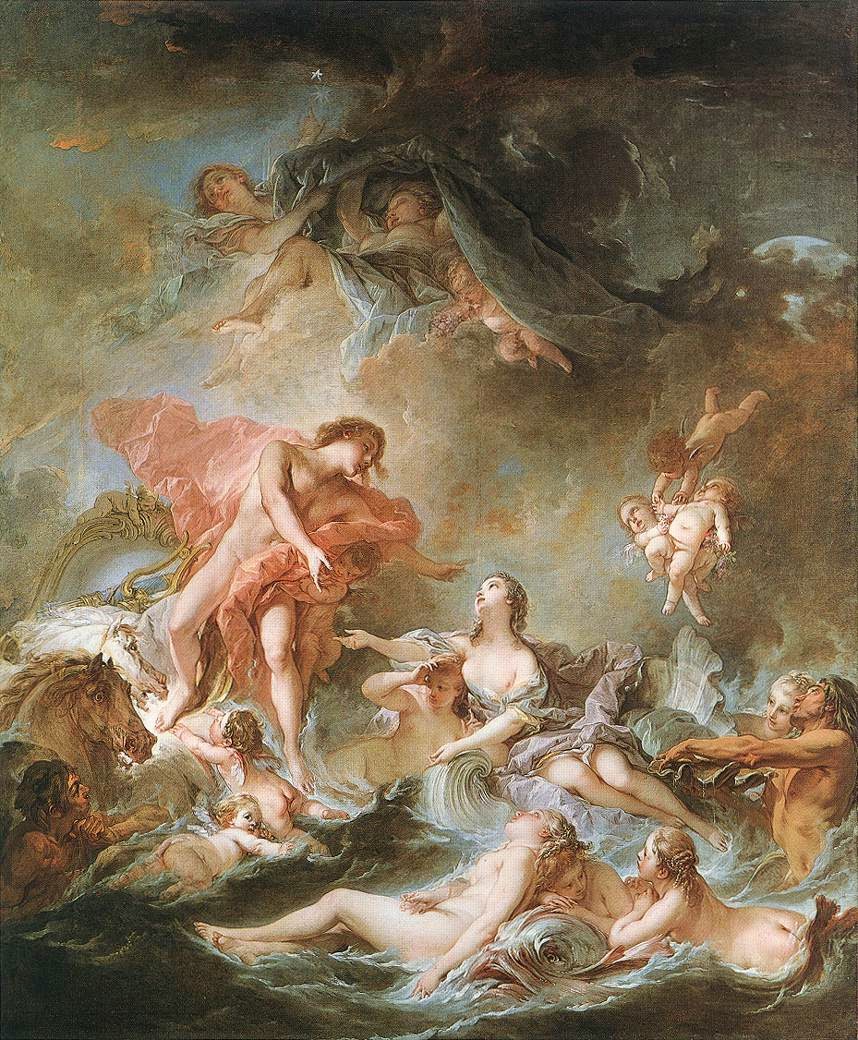
Boucher The Setting of the Sun, Wallace Collection. Image: WGA
Madame de Pompadour is welcoming Louis XV to bed
Monday, 30 June 2014
Yellow and purple
Links are a lazy way of making a point, finding degrees of
affinity or underlying meaning in coincidences are a substitute for profound originality. This shamelessly shallow post presents a
colour-coded association between the excessive frivolity of the ancien regime
and the socialist conscience of modern feminism, between Marie Antoinette’s favourite
dress shop and the intellectual salon of Simone de Beauvoir, both in Paris, two
centuries apart.
In the 1770s and 1780s, Rose Bertin’s shop on the rue Saint-Honoré was decorated in yellow and purple, including the painted imitation marble at the front entrance.
This leap-frogging post might be silly, but it is not ironic. By serendipity, it has landed on a revelation of women’s history through colour association. Complementary yellow and purple have been fashionable in gardening, interior and clothes design many times before, of course, and continue to be; there’s a striking use of the combination in the bed hangings of the Yellow or Velory Room at Ham House, home of the Duchess of Lauderdale, one of the most powerful operators at the heart of government and politics during the English Restoration.
The colours glowed in dingy old rooms like dappled sunlight; our ancestors brightened their interiors with hues that in electric light we recoil from as garish. The 18th century thought the same about the Baroque, throwing out all that brooding and blazing heaviness for enlightening, subtler tints and tones, not always pastel.
In any era, any tone, yellow and purple are an imperial choice. A hundred years later, Bertin’s Rococo yellow and lavender (not girlish pale pink or virginal white or fresh pea green or sky blue but majestic purple) declared her right to dictate fashion to rich consumers: I’m new, I’m self-made, I don’t care if you think I’m vulgar, I’m as good as you, you need me to tell you what to wear, I’m more powerful than any of you duchesses and princesses, I’m modern luxury retail, based on wealth and success, not birth and education, I’m the future.
Rose Bertin was the first successful female haute couturier, despised at the time as a pushy, business-woman, a jumped-up milliner challenging the social superiority of her clientele. Marie-Antoinette herself, the despised foreign queen hovering in the background, panniered and pomaded, a fashion victim in fantastically huge skirts overladen with lace and flowers, whose dignified death is regarded as the redeeming achievement of a wasted life; the Austrian bitch, the bored, stupid, rich wife, with her ridiculous hair-dos, seems to ask for re-evaluation......
In the 1770s and 1780s, Rose Bertin’s shop on the rue Saint-Honoré was decorated in yellow and purple, including the painted imitation marble at the front entrance.
From the late 1950s to 1980s, Simone de Beauvoir furnished
her Paris studio with yellow sofas and chairs on a purple carpet.

Detail of purple cardigan and yellow dress c 2014. Private collection. Image © 2014 MHP
This leap-frogging post might be silly, but it is not ironic. By serendipity, it has landed on a revelation of women’s history through colour association. Complementary yellow and purple have been fashionable in gardening, interior and clothes design many times before, of course, and continue to be; there’s a striking use of the combination in the bed hangings of the Yellow or Velory Room at Ham House, home of the Duchess of Lauderdale, one of the most powerful operators at the heart of government and politics during the English Restoration.
The colours glowed in dingy old rooms like dappled sunlight; our ancestors brightened their interiors with hues that in electric light we recoil from as garish. The 18th century thought the same about the Baroque, throwing out all that brooding and blazing heaviness for enlightening, subtler tints and tones, not always pastel.
In any era, any tone, yellow and purple are an imperial choice. A hundred years later, Bertin’s Rococo yellow and lavender (not girlish pale pink or virginal white or fresh pea green or sky blue but majestic purple) declared her right to dictate fashion to rich consumers: I’m new, I’m self-made, I don’t care if you think I’m vulgar, I’m as good as you, you need me to tell you what to wear, I’m more powerful than any of you duchesses and princesses, I’m modern luxury retail, based on wealth and success, not birth and education, I’m the future.
Rose Bertin was the first successful female haute couturier, despised at the time as a pushy, business-woman, a jumped-up milliner challenging the social superiority of her clientele. Marie-Antoinette herself, the despised foreign queen hovering in the background, panniered and pomaded, a fashion victim in fantastically huge skirts overladen with lace and flowers, whose dignified death is regarded as the redeeming achievement of a wasted life; the Austrian bitch, the bored, stupid, rich wife, with her ridiculous hair-dos, seems to ask for re-evaluation......
Saturday, 22 February 2014
The ministry of fashion
"Golden lads and girls....must come to dust."

Lord John and Lord Bernard Stuart
They were wrong but romantic; collateral damage of absolutism and revolution, teenage brothers, cousins of the king, transformed and immortalized by Van Dyck into an illusory image of English aristocracy that inspired fantasies still enjoyed today, including fictional upper-class heroes like the Scarlet Pimpernel and the 1930s gentleman detective, whose outward foppishness concealed brains and virility, and, more recently, re-invented as the modern meterosexual vampires of film and TV, whose lineage goes back beyond late Victorian Dracula, to Byronic heroes, Restoration libertines and doomed Cavalier youths.
Van Dyck, c. 1638. Oil on canvas, National Gallery, London. Image
source: WGA
Collateral damage of baroque absolutist illusion.
They were wrong but romantic; collateral damage of absolutism and revolution, teenage brothers, cousins of the king, transformed and immortalized by Van Dyck into an illusory image of English aristocracy that inspired fantasies still enjoyed today, including fictional upper-class heroes like the Scarlet Pimpernel and the 1930s gentleman detective, whose outward foppishness concealed brains and virility, and, more recently, re-invented as the modern meterosexual vampires of film and TV, whose lineage goes back beyond late Victorian Dracula, to Byronic heroes, Restoration libertines and doomed Cavalier youths.
The confident, sensual magnificence of
Baroque male fashion boasted feminine attributes; in
comparison, the presentation of ideal masculine sexuality of a hundred years
earlier - Henry VIII in his straddling stance jutting out his codpiece -
looks crudely insecure.
Even a realistic artist and social observer like Frans
Wednesday, 15 January 2014
Liberation and Self ownership
THE LAUREL TROPHY
part six

Hebe, the goddess of eternal youth
sculpted in marble by Canova, 1796-1817, Canova Museum, Possagno
Instead of carrying off the charming but vacillating Madame Récamier to his Berlin palace as his bride in 1808, Prince Augustus of Prussia took the famous portrait by Gérard, perhaps sensing that owning an archetype of the eternal feminine was a more prestigious investment than a legal bond with the living woman.
The real Madame Récamier was unfazed by the incorruptible beauty of her painted alter ego, while her own fortunes, looks and health faded, and continued to pursue her career as a salonnière. It is a relief to know that her vitality, charming conversation and good taste
were resilient to time and poverty. The cultural power generated by her reputation, that we would call her brand, was unassailable.
But something changed in her. At the age of forty she freed a
hidden self when....
Sunday, 22 December 2013
THE LAUREL TROPHY part four
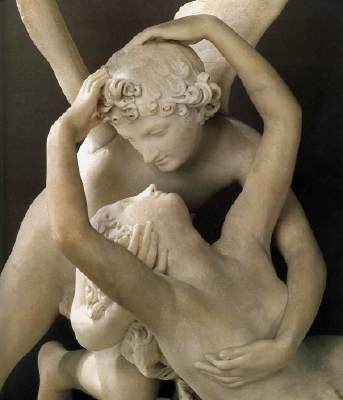
The erotic thrills of spiritual love: Canova's Cupid and Psyche
Marble, 1786-93, Musée du Louvre, Paris. Image source: Web gallery of Art
Marble, 1786-93, Musée du Louvre, Paris. Image source: Web gallery of Art
MADAME RÉCAMIER and THE PRUSSIAN PRINCE
In 1805, Napoleon exiled Madame Récamier from Paris. He had expected her to be a decoration, not a threat,
at his imperial court. Tyrants are always galled when a
pretty woman resists his authority. Paradoxes and anomalies are subversive by definition. Madame Récamier was feminine, gentle and sweet, and her reason for existence was personal power and influence.Undermined by Napoleon's spite, her charmed life was suddenly precarious. Her husband was bankrupt and their magnificent style of living was gone. She left France and travelled in Europe as a celebrity in her own right and as one of Napoleon's loveliest victims. Among the many men who laid siege to her was a swaggering young prince of Prussia with splendid black whiskers. August von Hohenzollern was one of the few distinguished men of his family with any brains or cultural sensitivity.....
Thursday, 5 December 2013
THE LAUREL TROPHY part three

Musée Carnavalet, Paris. Image source: Web Gallery of Art
The pose Madame Récamier adopted for portraits, the
lush sensuality of her appearance, the brilliant brown eyes and
luxuriant black hair,the pale skin of neck and shapely arms left bare,
even the hint of down on her
upper lip, that seemed to promise so much earthly pleasure, was so far
removed from her delicate personality that it was like performance art, in the late 18th century tradition of "attitudes."
The virginal banker's wife enjoyed role-playing an odalisque, and though most of the portraiture created in her youth exudes sex appeal, she remained all her life a symbol of femininity that could never be owned or exploited by anybody.....
The virginal banker's wife enjoyed role-playing an odalisque, and though most of the portraiture created in her youth exudes sex appeal, she remained all her life a symbol of femininity that could never be owned or exploited by anybody.....
Sunday, 24 November 2013
THE LAUREL TROPHY
part two
"She was one of the neo-Greeks who
rose, half naked indeed, but fully clad in their own modesty..."
(Arsène Houssaye, Notre-Dame de TJiermidor, 1866).
.
The nymph-bride stands under a laurel tree, timeless grace and chastity personified,
not disguising her expression of mischievous amusement: detail of the oval
portrait in oils of Madame Récamier, in her early twenties, c.1799, by
Eulalie Morin (1765 - 1837).
Musée National des Châteaux de
Versailles et du Trianon
As much as politicians, generals and philosophers, she was trying in her own way to make order out of chaos, contributing her own sensibility of what was best in old and new, while maintaining an unusual degree of independence in her private life. Outwardly avoiding the thunderbolts and lightning of her Romantic contemporaries, an arouser of unrequited passions in other people apparently unmoved by sexual desires herself, a good...
Wednesday, 18 September 2013
beyond the grave:
celebrity apotheosis
"Such is the power of novelty in England, that the newspapers next morning were full of the arrival of the foreign Beauty."
François-René de Chateaubriand, describing Madame Récamier's visit to London in 1802, in his autobiography,
Mémoires d'Outre-tombe, 1839
Mémoires d'Outre-tombe, 1839

Stipple engraving by Anthony Cardon, published by Francesco Bartolozzi, of Richard Cosway's portrait of Madame Récamier
THE LAUREL TROPHY part one

THE LAUREL TROPHY part one
She was twenty-four years old and the most famous social networker in Europe. At her first public appearance in London society, "she was swept to her carriage by the tide of people....The crowd followed hard on the fair foreigner’s heels. This phenomenon
was repeated every time she showed herself in public; the newspapers
resounded with her name, and her portrait, engraved by Bartolozzi, was
distributed throughout England." (Chateaubriand, Mémoires)
Juliette Récamier's personal qualities, and fashion sense, reacted uniquely with the cultural principles and fantasies of her time, which promoted the cult of the individual. Like Napoleon, she was born out of 18th century enlightenment and revolution, a gentler kind of opportunist who seized her moment, by collaborating on the creation of an image of femininity that Hollywood, fashion and pop music industries still mimic, a self-made goddess who dictated limits to her exploitation. She is one of the few women who attempted self-determination in popular and high culture and....
Juliette Récamier's personal qualities, and fashion sense, reacted uniquely with the cultural principles and fantasies of her time, which promoted the cult of the individual. Like Napoleon, she was born out of 18th century enlightenment and revolution, a gentler kind of opportunist who seized her moment, by collaborating on the creation of an image of femininity that Hollywood, fashion and pop music industries still mimic, a self-made goddess who dictated limits to her exploitation. She is one of the few women who attempted self-determination in popular and high culture and....
Tuesday, 21 May 2013
Among Tigers and Panthers....
Part Three
GERMAINE DE STAËL by Vigée Le Brun
 |
| Painter: Vigée Le Brun. Musée d'Art et d'Histoire, Geneva. Image source: Web Gallery of Art "Life often seems like a long shipwreck, of which the débris are friendship, fame, and love." |
Germaine
de Staël (1766-1817), writer of fiction, political propaganda, moral
and feminist essays, literary criticicism and autobiography, held the
most influential salon in France during the Directoire, was committed
against the principles of Empire and became one of Napoleon's most
eloquent opponents, moving her centre of power to her family home in
Geneva after he exiled her from Paris.
Ambitious and passionate, a profuse lover and loyal friend, she was an intellectual of international significance, who analysed the prevailing cultural and political trends of her age in the eye of the storm, and identified the whole of humanity's frailty in her own emotional needs - "We cease to love ourselves if no one loves us". She felt and lived in the C-minor key of Romanticism in all its anguished yearning and exhilarating self-assertion, writing in Réflexions sur le suicide: "Life often seems like a long shipwreck, of which the débris are friendship, fame, and love."
The classical motifs of this painting of her in the role of her own literary heroine Corinne, do not conceal either the subjective Romanticism of de Staël, daughter of Necker, the Swiss Protestant outsider appointed to reform the finances of the ancien régime, or the playful Rococo sophistication of Vigée Le Brun, who had achieved prominence through the patronage of Marie-Antoinette. Neither artist nor subject look fully at ease with the disciplines of neoclassicism from which de Staël's irreppressible energy bursts out in rebellion, making her the main force of nature in the landscape. She said she would rather suffer than be bored.
Turbans of various kinds, simple or decorated with plumes and jewels, that had reappeared as informal headwear for fashionable women, for the first time since the Renaissance, in the pre-revolutionary 1780s, became a craze after Napoleon's Egyptian campaign (1798 -1801).
Ambitious and passionate, a profuse lover and loyal friend, she was an intellectual of international significance, who analysed the prevailing cultural and political trends of her age in the eye of the storm, and identified the whole of humanity's frailty in her own emotional needs - "We cease to love ourselves if no one loves us". She felt and lived in the C-minor key of Romanticism in all its anguished yearning and exhilarating self-assertion, writing in Réflexions sur le suicide: "Life often seems like a long shipwreck, of which the débris are friendship, fame, and love."
The classical motifs of this painting of her in the role of her own literary heroine Corinne, do not conceal either the subjective Romanticism of de Staël, daughter of Necker, the Swiss Protestant outsider appointed to reform the finances of the ancien régime, or the playful Rococo sophistication of Vigée Le Brun, who had achieved prominence through the patronage of Marie-Antoinette. Neither artist nor subject look fully at ease with the disciplines of neoclassicism from which de Staël's irreppressible energy bursts out in rebellion, making her the main force of nature in the landscape. She said she would rather suffer than be bored.
FASHION and EMANCIPATION
Madame de Staël's Turban
Turbans of various kinds, simple or decorated with plumes and jewels, that had reappeared as informal headwear for fashionable women, for the first time since the Renaissance, in the pre-revolutionary 1780s, became a craze after Napoleon's Egyptian campaign (1798 -1801).
The headdress acquired prestige among intellectuals through its association with Madame de Staël, who wore enormous, attention-grabbing turbans of brightly coloured silks:
 |
| Germaine de
Staël in one of her famous turbans, c.1810, in a detail of a painting
attributed by different sources to François Gérard or, more likely from
the style and background, Anne-Louis Girodet de Roucy Trioson. |
Thursday, 18 April 2013
Among Tigers and Panthers...
Part Two
Anti-heroine or victim?
FRIDERIKA VON MECKLENBURG STRELITZ by Schadow
 |
| Terracotta bust, 1794, by Schadow. Nationalgalerie, Berlin. Image source: Web Gallery of Art |
The younger sister of Queen Louise had a tarnished career compared to the Prussian Madonna, in a much longer life circumscribed by unlucky marriages of convenience and necessity.
Aged 15, she drew the short straw in the double marriage of the
princesses of Mecklenburg Strelitz to two Prussian princes, the
virtuous, strictly monogamous heir to the throne, Frederick William, and
his more brilliant but dissolute younger
brother, Louis Charles, who died three years later.
Amid the usual double standards about male and female adultery, there were salacious rumours that during her marriage, Friderika, instead of meekly suffering her
unfaithful husband's neglect, retaliated by having an affair with one
of his uncles, Louis Ferdinand, who was only a year older than him, and
six years her senior.......
Sunday, 20 January 2013
The Faery Prince and Winged Time
A Jacobean Tragedy

Jacobean fantasy and hope for the future cut off before fruition:
Henry, Prince of Wales (1594-1612), armoured and hatted, rides on horseback,
with winged Time walking beside him. Oil painting by Robert Peake the Elder, c.1606-08. Peake (born c.1551) was the prince's official painter, producing iconography in the Elizabethan tradition, at odds with the bravura realism of contemporary European baroque art, already old-fashioned in England at the time of his appointment, and soon officially superseded by Isaac Oliver (of refugee Huguenot parentage) and Dutch and Flemish-born portraitists, but providing a transitional allegorical vision of royal mystique. This image is made poignant by our knowledge that death overtook the prince in the flower of youth. Image source: Wikipedia
On January 13th, 1605, Ben Jonson and George Chapman, two of the authors of
Eastward Ho!, were arrested and imprisoned on charges of sedition after a performance of the play at the
Blackfriars Theatre. The third playwright involved, John Marston, fled London to avoid arrest. The new King, James I, had only been in power for two years and the government
was particularly sensitive to criticism of the court; it was the same year as the Gunpowder Plot. Jacobean political censorship was motivated by immediate propaganda needs, trying to second-guess the reactions of domestic factions and foreign
powers, rather than by a programme of ideological oppression. The king, a published author, who regarded himself as a benevolent intellectual patriarch, believed in the power of disseminating words to convince minds, and his queen, Anne of Denmark, passionately loved theatre and performance...Henry, Prince of Wales (1594-1612), armoured and hatted, rides on horseback,
with winged Time walking beside him. Oil painting by Robert Peake the Elder, c.1606-08. Peake (born c.1551) was the prince's official painter, producing iconography in the Elizabethan tradition, at odds with the bravura realism of contemporary European baroque art, already old-fashioned in England at the time of his appointment, and soon officially superseded by Isaac Oliver (of refugee Huguenot parentage) and Dutch and Flemish-born portraitists, but providing a transitional allegorical vision of royal mystique. This image is made poignant by our knowledge that death overtook the prince in the flower of youth. Image source: Wikipedia
Sunday, 10 June 2012
Heredity and Rebellion
testing the limits of self-determination
part ten: Heredity and Rebellion

Atalanta
by Heinrich Keller, 1802, Kunsthaus, Zurich. Image
source: Web Gallery of Art
Atalanta, or "equal in weight": the princess had a sort of masculine rigour*
A might-have-been of history, one of the lost heirs to the throne, and the only one known for “rolling about”, Princess Charlotte of Wales is significant as a catalyst for national catharsis by dying young, not for any achievements in her life. Her real character was buried under decorous veils of Victorian sentiment, concealing the tension and flux of her personality, the combined result of inheritance and of her own response to the spirit of her times. Her individuality was puzzling to contemporaries, who tried to reduce it to "masculine rigour" and "acts" similar to Queen Elizabeth I's.
Like Blake’s Little Girl Lost, her impetuosity and candour, her instinctual behaviour, her sensual appetites, her enthusiasms, her wildness were disapprovingly held in check by adults. “Doucement, chèrie”, her urbane husband (the future “Uncle Leopold” of her cousin Victoria) would whisper to her whenever she got out of control in public, as if he was breaking in a horse....
Friday, 30 March 2012
Adornment and Concealment: fashioning a neoclassical queen
Queen Louise of Prussia
 |
| Louise of Prussia, when Crown Princess, 1796, by Tischbein. Image source: damals.de |
Tischbein's meltingly lovely evocations of Louise between 1794 and 1796 show off the legendary nymph-like beauty which made her a leader of German neoclassical fashion. She loved clothes, their colours and textures, and the make-believe powers of dressing-up. When she was young, she wore daringly modern, almost transparent, dresses, cut low in front and at the back, far more avant-garde than royal ladies are allowed to wear on public duty nowadays.
Subscribe to:
Posts (Atom)