Showing posts with label Character of Light. Show all posts
Showing posts with label Character of Light. Show all posts
Sunday, 15 October 2017
Sunday, 19 March 2017
Saturday, 19 October 2013
Chameleon and Narcissus
part four of The Character of Light
John Keats, Thomas Lawrence and the Brilliance Feminine
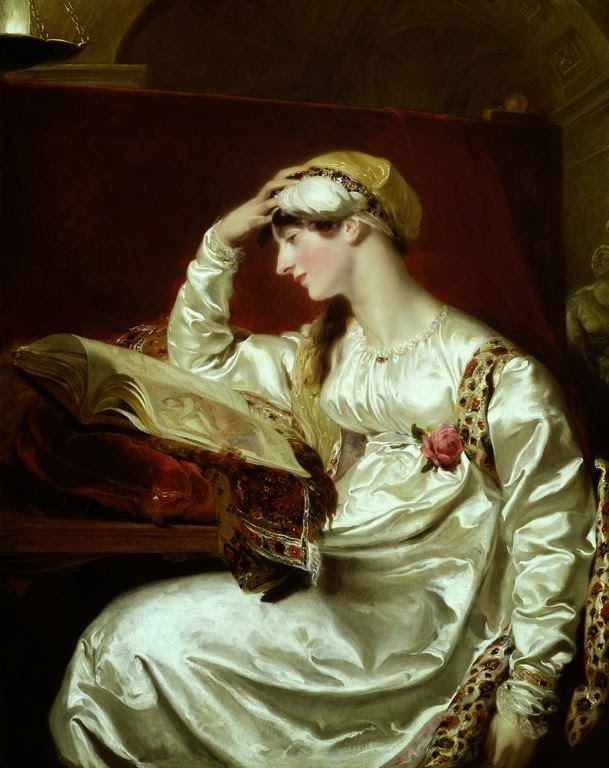
Sir Thomas Lawrence. Mrs. Jens Wolff, 1803 - 1815.
© The Art Institute of Chicago, Mr. and Mrs. W. W. Kimball
Collection.
We feed on the human drama; it stirs and nourishes us. The painting suddenly looks better. We must forget....

Monday, 7 October 2013
"The next Keats can only be a painter”
part three of The Character of Light
JOHN KEATS AND VICTORIAN PAINTERS

Edward Burne- Jones, Beguiling of Merlin, 1872 -77, Lady Lever Art Gallery.
Image source: Wikipedia
"La Belle Dame sans merci/Hath thee in thrall!"
Their admiration for his technique of conveying intensity of sensory experience was genuine - "the next Keats can only be a painter" observed Dante Gabriel Rossetti in a letter to William Morris - but like many apostles they distorted the intentions of their prophet.
Keats had.....
Sunday, 29 September 2013
the poet on the chain of art
part two of
The Character of Light
The Character of Light

"Misshapen monuments and maim'd antiques"
Byron, satirizing English Bards and Scotch Reviewers for gushing over the Elgin Marbles
He never wanted to be part of a school or movement. He saw himself as a student of life and art, not a precocious genius: “I cannot speak/ Definitively on these mighty things” he admitted in his Sonnet to Haydon after his first sight of the Elgin Marbles. When he wrote in a letter,“I never can feel certain of any truth but from a clear perception of its Beauty”, he was thinking the same as John Constable, who said“There is nothing ugly; I never saw an ugly thing in my life: for let the form of an object be what it may, – light, shade, and perspective will always make it beautiful.”

Constable, View in a Garden with a red house beyond, ca.1821, oil on canvas.
Copyright © Victoria and Albert Museum
Keats, like Constable, was not a mannerist artist, excluding or romanticising ugly realities; he was trying........
Sunday, 22 September 2013
synapse
for Catherine and DvP
The first thing you notice is the astonishing blue. It is a woman’s dress, with a luminous life of its own, a bright heart bursting out of a pale pink shell, made of the same colours as the blue sky, flushed pale carmine by the setting sun. Darkling, she “cannot see what flowers are at her feet, /Nor what soft incense hangs upon the boughs”. She has a woman’s head, but her body looks more like an exotic blue flower, a lady elf transforming from gordian to woman’s shape. Her dark curling hair might be part of a tree’s foliage.
Lady Bate-Dudley, oil on canvas c.1787. © Tate.
Her husband, Sir Henry, known as the Fighting Parson, was a loyal
friend and supporter of Gainsborough; he also wrote comic operas. The
Bate-Dudleys inhabited a surprisingly passionate landscape in their own lives.
Viewed as late 18th century society portraiture, Gainsborough’s painting of Lady Bate-Dudley is disconcerting, being far more about abstract colour and light than the status of the sitter; as poetry of art, it perfectly evokes states of mind painted in words by Keats.
Gainsborough was a poetic painter, Keats the most painterly of poets in an age inspired by unbounded imaginative affinities. Keats’ liquid imagery was as often in danger.....
Subscribe to:
Posts (Atom)