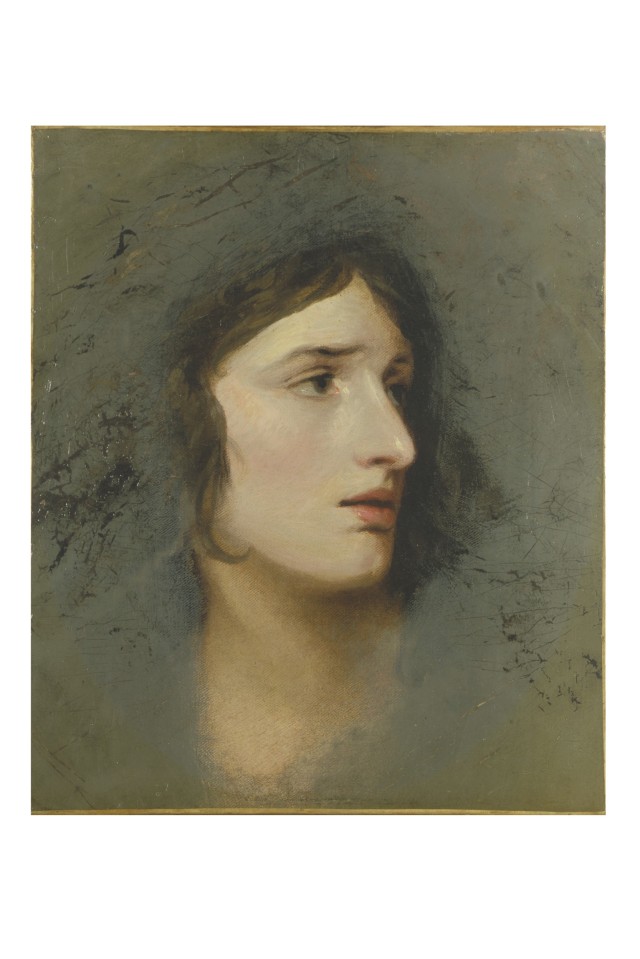
Friday, 12 December 2014

In this world and the next: a tragedy of gender and celebrity


 Sarah Siddons as Euphrasia in 'The Grecian Daughter'. Print of Pine's painting by the female engraver, Caroline Watson. Published in London by John Boydell, 1st May, 1784. © Victoria & Albert Museum. Euphrasia was one of the parts in which she conquered the London stage on her return in 1782. The heroine triumphs in restoring peace to her country after an extraordinary, even gross, display of filial duty, when she suckles her own father rather than escape to safety from despotic tyranny with her husband and infant son. The mix of sensationalism - the audience enjoyed shrieking along with the heroine - and serious moral about debate a woman's right to determine her public and domestic roles, without becoming a victim, were ideal for Sarah Siddons' stage persona.

 PART TWO - A Woman's Tragedy
Mrs Siddons understood the value of art, both as an aesthetic and a publicity tool. Her collaboration with all the leading portraitists of the day and the subsequent national distribution of prints spread her fame. She was not an easy subject; she was considered a beautiful woman, in her strong featured face, large dark eyes and lithe, graceful body, but, as often happens with expressive, charismatic people, her beauty could not be captured in repose.

Many of the heroic qualities that she was admired for on stage were regarded as unsuitable for a lady in real life. The power she conveyed with the grandeur of her elocution and sweeping, authoritative movements, were supposed to be exclusively masculine attributes. Except for Thomas Lawrence, society portraitists shied away from her forcefulness, emphasizing instead her willowy grace, and the tender beseeching pathos of her raised eyes, rather than showing them blazing with passion under frowning brows.


Sitting in her elegant black plumed hat and blue-striped dress in Gainsborough's 1785 portrait, she looks uneasy, coiled, as if she'd rather spring up and save her country, defy a tyrant, or murder Duncan.


When Lawrence painted Mrs Siddons, rather than avoiding the challenging masculine aspects of her stage persona, the fierce concentration of her gaze, her imposing height and the athletic build of her shoulders and arms (reminiscent of Mrs Freke’s “masculine arms” in Maria Edgeworth’s Belinda), he celebrated them.
 
Mrs Siddons 1804 by Sir Thomas Lawrence 1769-1830
Portrait by Thomas Lawrence, Tate Gallery, London. Image:© Tate, London 2011
The Tragic Muse of Neoclassicism and prophetess of Romanticism in a portrait of 1804, when she was nearing fifty, in which her lifelong friend, Sir Thomas Lawrence displayed her powerful physique and brooding presence with such panache that she looks like a bruiser about to step forward and knock you out. Like many great classical actors she combined masculine and feminine qualities in the authority and sensitivity of her interpretations.


When Lawrence painted Mrs Siddons, rather than avoiding, like other portraitists, the challenging masculine aspects of her stage persona, the fierce concentration of her gaze, her imposing height and the powerful build of her shoulders and arms (reminiscent of Mrs Freke’s “masculine arms” in Maria Edgeworth’s Belinda), he celebrated them.


For the last full-length portrait, after the natural studio light from the high source used by Lawrence faded, she posed by lamplight till two o’clock in the morning, so he could finish the painting in time for the Royal Academy Exhibition of 1804. The night-time sitting caused such slanderous tittle-tattle around town that Mr Siddons had to issue a press statement denying his wife's adultery. Any lady of any age who sat for Lawrence risked seduction - he was dangerous to know while Byron was still a schoolboy. Mrs Siddons and Lawrence were not lovers, they were something even closer, intimate collaborators who understood the demands of each other's arts.


She steps forward towards us as she would have done during one of her Shakespearean readings; the simple composition is neoclassical, except for the free brush work, the great swathes of red and black, the injury in her expression, all suggest emotional disturbance beneath the surface of acting. It was the year after her eldest daughter's death; a younger one had died five years before. With "two lovely creatures gone", their grieving mother, comparing herself to Niobe, had begun to look older and heavier, which Lawrence did not disguise.


There is nothing of the "flattered and pinky" which Farington objected to in some of Lawrence's society portraits. The painting did not go down well at the time, but when you physically enter her presence, the effect is breathtaking, and you suddenly get a sense of her power on stage without even being able to hear her voice.

We think of one as the treasure of the Establishment, rendering female passions socially acceptable, and the other its scourge, but Sarah Siddons and Mary Wollstonecraft had social and cultural affinities....They were only five years apart in age, and well-acquainted.They had to earn their own livings all their adult lives; as young women struggling to establish independent careers, they had both taken jobs as ladies' companions.

What could have been a humiliating experience for the sixteen year old Sarah Kemble, forced to work as a maid in the house of landed gentry while she burned to be an actress, turned out to be more like a cultural education than servitude. Like Elizabeth Bennett seeing Pemberley for the first time, she walked into 18th century enlightenment. She was already well-educated in literature and drama, and now daily exposure to the Greatheed family's art collection inspired her appreciation of the visual arts, and a special interest in sculpture.


The manor house at Guy's Cliffe, Warwickshire, by Alexander Francis Lydon, from 'County Seats of the Noblemen and Gentlemen of Great Britain and Ireland', 1880.
Image: Wikipedia.
Not a theatre set, but a real house that informed a dramatic imagination. As was so common in the 18th century, the picturesque idyll and magnificent art collection was paid for by sugar plantations

She was treated kindly, even with respect, and soon promoted from maid to companion; everyone, masters and servants, seem to have been enthralled by her recitations; her habit of spouting Milton in the servants' hall didn't annoy anyone - it begins to sound like a fairy story, an episode in a preposterous TV drama.

The new maid carried herself so grandly around the house, that her amiable employer Lady Mary (oh, yes, that was her name), a Whig duke's daughter, later recalled how she had had an irresistible urge to rise from her chair whenever the girl entered the room. Her subsequent fame might have coloured this recollection, for nothing succeeds like success in shifting perceptions, but it is still an illustration of how, in the age of aristocratic supremacy, Sarah Siddons, who had been born in a small tavern in Brecon, was treated like a queen. 


Mrs Siddons by Richard Crosse, 1783, watercolour miniature © Victoria & Albert Museum. Here, in a poor likeness conveniently packaged for publicity, she looks like a typical 18th century lady of sensibility. Her features deliberately softened by the painter, she is the epitome of feminine grace and moral virtue in a temperate classical setting, a very small part of her dramatic range. The insipidity of this type of portrayal of women annoyed Siddons and Wollstonecraft. “[I]f we revert to history, we shall find that the women who have distinguished themselves have neither been the most beautiful nor the most gentle of their sex.” (Mary Wollstonecraft, A Vindication of the Rights of Woman)


TO BE CONTINUED

Tuesday, 2 December 2014

In this world and the next:a tragedy of gender and celebrity

“Perhaps in the next world women will be more valued than they are in this.”
SARAH SIDDONS (1755 - 1831)

PART ONE - A Celebrity's Tragedy
2006AV2988 
Sarah Siddons, oil on canvas c 1784, attributed to William Hamilton (or Thomas Beech).
© Victoria and Albert Museum.

Siddons dominated the female tragic roles on the English stage for over 30 years. Her stately performances in the most emotionally immediate of art forms articulated the eighteenth century's ideal of the sublime, and her representations of the classical passions, in combination with her outwardly virtuous private life, won over audiences as diverse as George III, who appointed her Reader to his family, and Lord Byron, who admired her more than any other actor, male or female, worth more than Cooke, Kemble and Kean all put together. Even the Duke of Wellington, as famous for dry understatement as she was for grand pathos, was a fan.

Going to see her act was like an ecumenical religious event. Hazlitt said she was a goddess, Tragedy personified. By the time she died in 1831, she had outlived two kings, her friend, the portraitist Lawrence, the poet Byron, her brother and fellow-actor John Philip Kemble, her upstaged and discarded husband William Siddons, and, worse than anything that a mother should endure, five of their children, but not her reputation.

The mystique of the Tragic Muse had been preserved, but only just. Even before her formal retirement in 1812, something had gone wrong. "She was no longer the same...." complained Hazlitt of her inaudibility and disproportionate emphases. She kept making ill-advised and distressing comebacks: "her voice appeared to have lost its brilliancy"; "....she laboured her delivery most anxiously as if she feared her power of expression was gone" (Robinson).

She had gone from goddess to joke.

Saturday, 22 November 2014

Out of the killing sun

PART FIVE OF ROMANTIC FICTIONS AND CASUALTIES

 Adam Buck, Two Sisters, print, 1796. London.
© Victoria and Albert Museum, London
Sense and sensibility, reason and passion, love and illusion, neoclassicism and romanticism dancing on the eve of cataclysm.
During the years 1795 to 1797, while the two elder Siddons sisters were engaged in their own danse macabre with Thomas Lawrence, Jane Austen wrote her first draft of the novel that was eventually published in 1811 as Sense and Sensibility.

It should have been the end, the two beautiful girls consumed by passion and disease, but the Tragic Muse had another daughter, only nine years old when her eldest sister died, a child with a name like the peal of golden bells under a blue sky, a tiny Buddha with a ferocious will [1] and eyes that glared like a torch in the night on the charades and vacillations of grown ups. 

After Sir Thomas Lawrence, Cecilia Combe, (née Siddons), 1798. Lithograph by Richard James Lane, printed by Charles Joseph Hullmandel, published by Joseph Dickinson,
May 1830. © National Portrait Gallery, London. She glares out of the picture
with fanatical fervour, lowering her brows like her mother did in dramatic parts.

Her resemblance to the second of her elder sisters was so close in "all the dazzling, frightful sort of beauty that irradiated the countenance of Maria" [2] that she made the Tragic Muse shudder.

She was designated the last companion of the goddess, the comfort of her melancholy age, and custodian of her shrine. For twenty-eight years the purpose of her existence was to serve her mother, who stared back at her with vacant eyes, in "apparent deadness and indifference to everything". [3]

But the youngest daughter had a flame inside her that would not be quenched.  She had a gift denied her sisters. She did not breathe the same fatal air as they had done. She outlived her mother to write her own last act. She was determined that it would be not be a tragic one.

Her sisters' ghosts haunted her girlhood, her memory of them based more on other people’s accounts than her own recollections; they were cautionary figures from myth, glimpsed in faded portraits and drawings, girls who should have been entwined in their youthful loveliness, but were sundered by bitterness, wraiths straying in the seductive heat of their mother's and an artist's imaginations, to fall and drown in the pool of Narcissus.

In 1798, the two elder daughters of the Tragic Muse had pursued love to give them individual identity in a revolutionary world that seemed to offer a new dawn to men and women. They had hoped, like the two young step-sisters who wnent on an adventure of free love with Shelley and Byron in the lakes and mountains of Europe sixteen years later, to find "an immortality of passion."[4]

Tuesday, 18 November 2014

Romantic Fictions and Casualties

Part Four:
The Prophetess and the Muse

Shortly after the death of the eldest daughter of The Tragic Muse, whom he had once thought he loved, in the same year of 1803, the artist found his ideal of physical and intellectual femininity personified in an elegant and composed woman, a refined and independent spirit who understood his temperament and his art. She was about the same age as the daughter of tragedy, perhaps a few years older, tall and dark like her, but uncomplicated by illness and sisters.

She was a model of discretion as much as beauty, a social sophisticate who made no demands on him. She did not need marriage to consummate their friendship so not a breath of scandal marred the artist's reputation ever again. Her gratification came from inspiring and guiding him to create works that would invest her with immortality by association. She was his perfect muse.

The shining culmination of the artist's love of his muse:
Sir Thomas Lawrence. Mrs. Jens Wolff, 1803 - 1815. 
© The Art Institute of Chicago, Mr. and Mrs. W. W. Kimball Collection.
At the time she first met Lawrence, Isabella Anne Hutchinson was unhappily married to the Danish diplomat and art collector Jens Wolff from whom she later separated in 1810.

He spent twelve years painting her portrait, and it was the most emotionally tender image of a woman he ever created.

The éclat of her splendid aquiline profile, gracefully bent in contemplation of Michelangelo's drawings, recalled the artlessly drooping head of the dead girl he had tried to love, listening to her own thoughts, composing her own songs. If he had been a woman, this was how he would like to have been painted, and loved.


The Tragic Muse carried on working for a few more years after her eldest daughter's death, but she had lost some of her elemental power. The people no longer worshipped as before. They demanded to see her in the same parts, then criticized her for using “her great guns” too soon, never caring that the goddess in person really was "in paroxysms of agony".[1]

Her presence had always been monumental, but now her body had grown so heavy that could not get up without help during performances. People felt sorrier for the woman herself than the characters she was playing.

William Blake,Hecate or the Three Fates c. 1795. Tate Gallery, London. 
Image source: WGA

Despite her habit of standing outside herself, so she could control the effect she was making, mortality had overrun her divine gift. Either her own emotions had burst their banks and flooded the character she was imagining, or public taste in deities was changing....

Friday, 14 November 2014

Romantic fictions and casualties

PART THREE: SILENCE

 Silence by Fuseli, 1799-1801
Oil on canvas, Kunsthaus, Zurich. Image source: WGA

The lightning struck, and receded, the earth quaked and settled again. Resolute, she never spoke again of love and betrayal. She began to believe that the artist had never loved her for her own sake, but more for the sensation of passion, a drama of love, in which she and her sister had been no more to him than sparks of her mother's fire. She knew her mother and he still met, an ageing goddess and her acolyte, and she did not say a word of reproach to either of them.

But the worm had entered the bud. During the next five years, while his fame as an artist and a lover spread, and queens and princes were seduced by him, and still he wore his sweet-sad smile, she started to wither away until her own muse fled - “I sing but little now to what I did once”. She had lived only to give joy to those she loved, and she had no joy left. She had reached the limits of feeling. She lived, but it was the posthumous existence of despair.
Every asthma attack was like a drowning, in which to die would be easier than the struggle for breath. She yielded to invalidism as if it was a lover. 

She never lost faith in her mother, she would always be the chief priestess of the Tragic Muse, ensuring nothing distracted the goddess, knowing that the slightest shift of wind might upset the sacred artifice of her art, causing the goddess to misjudge her timing or overreach her power to represent emotion from feeling too much, performing worst when she most ardently wished to do better than ever.[1]

Her breath got shorter and shorter. Even when she knew she was dying, the eldest daughter did not want to cause her mother trouble. There was never any question that the goddess must continue working while her daughter was ill, often travelling far away, giving spiritual sustenance to her worshippers on other islands to pay for medicine, food, clothing and lodgings for her family.  All her life the girl had suffered in her mother's absence which created a vacancy in her heart that nothing else could fill [2] but she and her father, a mere mortal player, not a god, who relied on his wife's earnings to maintain their household, kept the worst news to themselves.


Drawing of Sarah Siddons, artist and date unknown  © Victoria and Albert Museum 
 

At last there came a day when an attendant dared tell the Tragic Muse that her daughter was dying. "Will you believe I must play tonight!" [3] exclaimed the distraught mother. She had always known that she was not immortal, as people wanted her to be, but rather an heroic victim of her own powers of arousing emotion. She broke her contract so she could rush home, but her journey across the sea was delayed by great storms, which neither her dramatic arts nor maternal appeals could appease, and when she arrived, her lovely child, her sweet Sally, was already dead.


Claude-Joseph Vernet, Nocturnal Seastorm 1752
Oil on canvas. Private collection. Image source WGA


[1] Paraphrasing Sarah Siddons' much quoted piece of self-criticism that holds true for all actors, from her letter to Rev. Whalley, 16 July, 1781, published in The Kembles, Percy Fitzgerald, 1871: "Sorry am I to say, that I have often observed I have performed worst when I have most ardently wished to do better than ever"[2] Paraphrasing Letter from Sally Siddons to Miss Bird, 15 September, 1798, quoted by F.M.W. Parsons, The Incomparable Siddons, 1909, p.199.
[3] Paraphrasing Letter from Mrs Siddons to Mrs Fitzhugh, quoted by Parsons, p.204

Saturday, 8 November 2014

Romantic fictions and casualties

PART TWO: The temple of delight

 
Fragonard, The Fountain of Love 1785. Oil on canvas, Wallace Collection, London.
Image source: WGA. In this painting, the purveyor of insouciance and erotica for the ancien regime breaks into the psychological dreamworld of the Neoclassicists and Romantics.
"I fly with HORROR from such a passion" Sally Siddons

The Tragic Muse's eldest daughter had loved the artist steadfastly even after he had forsaken her for her younger sister, a pretty, airheaded girl of sixteen he decided, on an impulse, to marry. 

During this gaping wound in time, her two years of "mortification, grief, agony", a new kindling began inside her. Under layers of suffering, she heard more clearly the music of her calling. 

Passion reverberated in her, enriching her voice with sweetness, her melodies with mortal yearning: “I never should have sung as I do had I never seen you; I never should have composed at all. . . You then liv'd in my heart, in my head, in every idea…”. 

She had turned a fallible man into her muse, and given birth to her own art.

Saturday, 1 November 2014

Romantic fictions and casualties

“I never should have sung as I do had I never seen you; I never should have composed at all. . . You then liv'd in my heart, in my head, in every idea…” 

 
The Art of Loving or The Pleasant Lesson, furnishing fabric,
Favre Petitpierre et Cie (possibly, maker), ca.1785-1790, detail © Victoria and Albert Museum, London

PART ONE
One autumn long ago, while Britain was at war with revolutionary France, whose armies under Napoleon had conquered most of mainland Europe, and the people at home were rejoicing at Nelson's victory at the Battle of the Nile that saved the Middle East, while Irish rebels were fighting their English oppressors with the help of the French; while Jenner's findings on vaccination against the mass killer small-pox were being published; while a new kind of poetry was being read for the first time in Coleridge and Wordsworth's collection of Lyrical Ballads, while quietly in a village in Hampshire Jane Austen was writing Northanger Abbey, and a new kind of woman appeared in a novel called Maria: or, The Wrongs of Woman by Mary Wollstonecraft; while the external world was spinning and bleeding and crying and laughing, the eldest daughter of the Tragic Muse renounced forever the man she loved. 

He was a charming young artist who painted everyone as if he was in love with them. His pencil, chalk and brush had the power of Cupid's arrows to pierce men and women with the flushed, breathless heat of desire. When he looked at someone, however dull they had felt the moment before, they saw the reflection of beauty in his eyes. 


François-AndrĂ© Vincent, Zeuxis Choosing his Models for the Image of Helen from among the Girls of Croton 1789. 
Oil on canvas. Private collection. Image source: WGA

He was....

Monday, 30 June 2014

Yellow and purple

Links are a lazy way of making a point, finding degrees of affinity or underlying meaning in coincidences are a substitute for profound originality. This shamelessly shallow post presents a colour-coded association between the excessive frivolity of the ancien regime and the socialist conscience of modern feminism, between Marie Antoinette’s favourite dress shop and the intellectual salon of Simone de Beauvoir, both in Paris, two centuries apart.

In the 1770s and 1780s, Rose Bertin’s shop on the rue Saint-HonorĂ© was decorated in yellow and purple, including the painted imitation marble at the front entrance.


From the late 1950s to 1980s, Simone de Beauvoir furnished her Paris studio with yellow sofas and chairs on a purple carpet.

Detail of purple cardigan and yellow dress c 2014. Private collection. Image © 2014 MHP

This leap-frogging post might be silly, but it is not ironic. By serendipity, it has landed on a revelation of women’s history through colour association. Complementary yellow and purple have been fashionable in gardening, interior and clothes design many times before, of course, and continue to be; there’s a striking use of the combination in the bed hangings of the Yellow or Velory Room at Ham House, home of the Duchess of Lauderdale, one of the most  powerful operators at the heart of government and politics during the English Restoration.

The colours glowed in dingy old rooms like dappled sunlight; our ancestors brightened their interiors with hues that in electric light we recoil from as garish. The 18th century thought the same about the Baroque, throwing out all that brooding and blazing heaviness for enlightening, subtler tints and tones, not always pastel.

In any era, any tone, yellow and purple are an imperial choice. A hundred years later, Bertin’s Rococo yellow and lavender (not girlish pale pink or virginal white or fresh pea green or sky blue but majestic purple) declared her right to dictate fashion to rich consumers: I’m new, I’m self-made, I don’t care if you think I’m vulgar, I’m as good as you, you need me to tell you what to wear, I’m more powerful than any of you duchesses and princesses, I’m modern luxury retail, based on wealth and success, not birth and education, I’m the future.

Rose Bertin was the first successful female haute couturier, despised at the time as a pushy, business-woman, a jumped-up milliner challenging the social superiority of her clientele. Marie-Antoinette herself, the despised foreign queen hovering in the background, panniered and pomaded, a fashion victim in fantastically huge skirts overladen with lace and flowers, whose dignified death is regarded as the redeeming achievement of a wasted life; the Austrian bitch, the bored, stupid, rich wife, with her ridiculous hair-dos, seems to ask for re-evaluation......

Tuesday, 24 June 2014

Second Coming

Weak plotting, naff (native) British accents, His Smug Unctuousness cast as the PM, abetted by a panto villainess, cut off the frayed ends of our suspension of disbelief. Jack Bauer, the great malcontent of the early 2000s, the anti-hero of counter-everything, the TV construct that some of us cleaved to as our best friend and rescuer, is diminished, not revived. He knows it, because he is whispering more hoarsely than ever.

Wonderful, incomparable Sarah Lund, I love you, I miss you - don't come back.
THEY ARE ALL GONE INTO THE WORLD OF LIGHT

Friday, 6 June 2014

contrablog (2)

"You don't call yourself a writer because you have some free time and your heart is aching....Writing is a serious activity, a profession. Not a pastime." 
Simone de Beauvoir quoted by Claudine Monteil in The Beauvoir Sisters, English translation © 2004 by Marjolijn de Jager. 
The same is true of painting, photography and acting. 
It should mean the end of this blog....

Young Woman Drawing by Marie-Denise Villers, 1801. 
Metroplitan Museum, New York. Image source: Wikipedia

Saturday, 31 May 2014

WELCOME


http://pippa-rathborne-actress.blogspot.com/

Inspired by her talented and courageous parents, Pippa Rathborne
never thought of being anything but an actor. She has worked in theatre, TV and film since she was 22. She has a wide dramatic and light comedic range in both contemporary and classical texts. Born and based in London, she has toured the United Kingdom, and also worked in Europe and Hong Kong, in everything from modern English classics and Shakespeare to improvised comedy and murder mysteries. She is also an experienced role-player for legal and medical training courses.

PORTFOLIO, CV & CONTACT on


posts on history, daily life, art, theatre, film, culture

Hamburg 2010

London 2012
Cannes 2009
Hamburg 2010

Calico

rebegot of darknessPlease don't ask me how I feel.
In the garden of how I feel
nothing grows
but tears and sighs and bitter aloes.
I cannot speak my sorrow:
it swells inside me, fungating tumour,
choking words and ulcerating thoughts.

In the garden of how I feel,
there is no light; sunken corner
of mind's eye
diseased, where knotted stems writhe and mould,
mandrakes scream, torn out of earth,
and the angry rustling of ivy leaves
sirens that rats are tunnelling through.

It’s their garden now; dead ones stink
where lily and rose used to be.
Memory
by violence of absence mutates,
past and present are displaced -
love severed, nothing looks nor feels the same
that once was seen and felt by her, too.

enchantedPlease don’t tell me, then, to “move on”-
raw amputee crawling towards
a closed door.
Let me journey in catacombed mind
to resurrect the garden,
replant her flowers, released,
in sweet disorder, out of stone and clay,
ancient art of heartbreak colours mixed;

rare slender straight-backed gallantry,
supple as swaying summer stems;
make-believe
like her the most while having little -
her calico mystery -
I see her - quick - she’s climbed the tree again -
she stands, laughing in the dappled light.

Sunday, 25 May 2014

cutting edge of fashion

Nothing becomes a rich person so ill as telling a poor one that money can't buy happiness, but I sympathize with them that it doesn't always buy beauty or good taste.  Looking at the clothes in Harvey Nichols the other day, for the first time in seven years, I have never seen so much I didn't want.* It is consoling to know that you can dress just as sluttily or frumpily from the local mall as you can from Knightsbridge.

But where is exquisite wearable art to be found in London today if it's not in "premier luxury retail"? It doesn't matter that the prices are out of my reach - the famous department stores have the power to inspire us all by showcasing the best, not dumb fashion down. Capitalism is failing in its moral justification to broker beauty. Producing and buying expensive stuff for the sake of its cost alone is not enough; wealth is not its own reward.

 Jean-Francois Janinet, Marie Antoinette, a print after Jean-Baptiste-AndrĂ© Gautier-Dagoty
France, 1777. Mixed method colour print on two sheets of paper. © Trustees of the British Museum

Good taste and beauty are not always the same thing, of course. One implies reason, order, restraint - the other can be terrifying....