Few people’s childhood impressions are recalled with as much honesty and
poignant detail as Sarah's. She conjures the enormity of the smallest things, and the intensity of the desire to own every emotion, every moment.
With many thanks to Sarah, the first part of COMFORT IN A COTTON FROCK is reblogged from First Night Design
I wish Anne would come. Wednesday Anne. I want to help her today: I want to use the dustpan and brush. She’s broken her arm again so she can’t do any cleaning without me. I love her. How pretty you are, she says. I couldn’t do any of this without your help, she says. How I love her. She’s been around for ages and is even older than Mummy and Daddy. She used to clean for Ellen Terry and Ellen Terry was very famous and from very, very long ago. Charles-Who-Had-His-Head-Chopped-Off was around then. I think. I want to be Ellen Terry.....
Thursday, 30 January 2014
Wednesday, 15 January 2014
Liberation and Self ownership
THE LAUREL TROPHY
part six

Hebe, the goddess of eternal youth
sculpted in marble by Canova, 1796-1817, Canova Museum, Possagno
Instead of carrying off the charming but vacillating Madame Récamier to his Berlin palace as his bride in 1808, Prince Augustus of Prussia took the famous portrait by Gérard, perhaps sensing that owning an archetype of the eternal feminine was a more prestigious investment than a legal bond with the living woman.
The real Madame Récamier was unfazed by the incorruptible beauty of her painted alter ego, while her own fortunes, looks and health faded, and continued to pursue her career as a salonnière. It is a relief to know that her vitality, charming conversation and good taste
were resilient to time and poverty. The cultural power generated by her reputation, that we would call her brand, was unassailable.
But something changed in her. At the age of forty she freed a
hidden self when....

Wednesday, 1 January 2014
Pictures within pictures - which one is true and who owns the truth?
THE LAUREL TROPHY, part five

Detail of La Chambre de Madame Récamier à l'Abbaye-aux-Bois
by François-Louis Dejuinne, 1827, showing Gérard's painting of Madame de Staël in the character of her literary heroine, Corinne, at top right.
After Madame de Staël's death in 1817, Prince August of Prusia commissioned a painting of her in the character of her most famous heroine, Corinne, as a gift for Madame Récamier. Among de Staël's most treasured possessions at Coppet had been a portrait and bust of Juliette.
These were not mere sentimental souvenirs of idealized female friendship. Public relations, mutual admiration and ideological statement all contributed to the self-created cult of two very different women who recognized their complementary attributes. One was a brainy, brilliant, pushy, sexually liberated published author, the Sappho of her times, and the other....
Sunday, 22 December 2013
THE LAUREL TROPHY part four
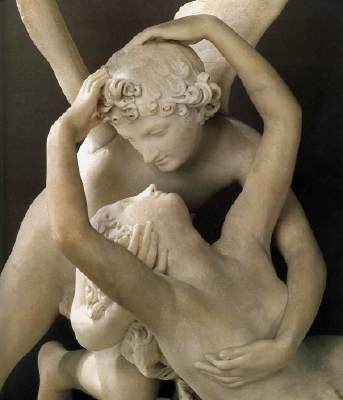
The erotic thrills of spiritual love: Canova's Cupid and Psyche
Marble, 1786-93, Musée du Louvre, Paris. Image source: Web gallery of Art
Marble, 1786-93, Musée du Louvre, Paris. Image source: Web gallery of Art
MADAME RÉCAMIER and THE PRUSSIAN PRINCE
In 1805, Napoleon exiled Madame Récamier from Paris. He had expected her to be a decoration, not a threat,
at his imperial court. Tyrants are always galled when a
pretty woman resists his authority. Paradoxes and anomalies are subversive by definition. Madame Récamier was feminine, gentle and sweet, and her reason for existence was personal power and influence.Undermined by Napoleon's spite, her charmed life was suddenly precarious. Her husband was bankrupt and their magnificent style of living was gone. She left France and travelled in Europe as a celebrity in her own right and as one of Napoleon's loveliest victims. Among the many men who laid siege to her was a swaggering young prince of Prussia with splendid black whiskers. August von Hohenzollern was one of the few distinguished men of his family with any brains or cultural sensitivity.....
Thursday, 5 December 2013
THE LAUREL TROPHY part three

Musée Carnavalet, Paris. Image source: Web Gallery of Art
The pose Madame Récamier adopted for portraits, the
lush sensuality of her appearance, the brilliant brown eyes and
luxuriant black hair,the pale skin of neck and shapely arms left bare,
even the hint of down on her
upper lip, that seemed to promise so much earthly pleasure, was so far
removed from her delicate personality that it was like performance art, in the late 18th century tradition of "attitudes."
The virginal banker's wife enjoyed role-playing an odalisque, and though most of the portraiture created in her youth exudes sex appeal, she remained all her life a symbol of femininity that could never be owned or exploited by anybody.....
The virginal banker's wife enjoyed role-playing an odalisque, and though most of the portraiture created in her youth exudes sex appeal, she remained all her life a symbol of femininity that could never be owned or exploited by anybody.....
Sunday, 24 November 2013
THE LAUREL TROPHY
part two
"She was one of the neo-Greeks who
rose, half naked indeed, but fully clad in their own modesty..."
(Arsène Houssaye, Notre-Dame de TJiermidor, 1866).
.
The nymph-bride stands under a laurel tree, timeless grace and chastity personified,
not disguising her expression of mischievous amusement: detail of the oval
portrait in oils of Madame Récamier, in her early twenties, c.1799, by
Eulalie Morin (1765 - 1837).
Musée National des Châteaux de
Versailles et du Trianon
As much as politicians, generals and philosophers, she was trying in her own way to make order out of chaos, contributing her own sensibility of what was best in old and new, while maintaining an unusual degree of independence in her private life. Outwardly avoiding the thunderbolts and lightning of her Romantic contemporaries, an arouser of unrequited passions in other people apparently unmoved by sexual desires herself, a good...
Friday, 25 October 2013
The Character of Light

Saturday, 19 October 2013
Chameleon and Narcissus
part four of The Character of Light
John Keats, Thomas Lawrence and the Brilliance Feminine
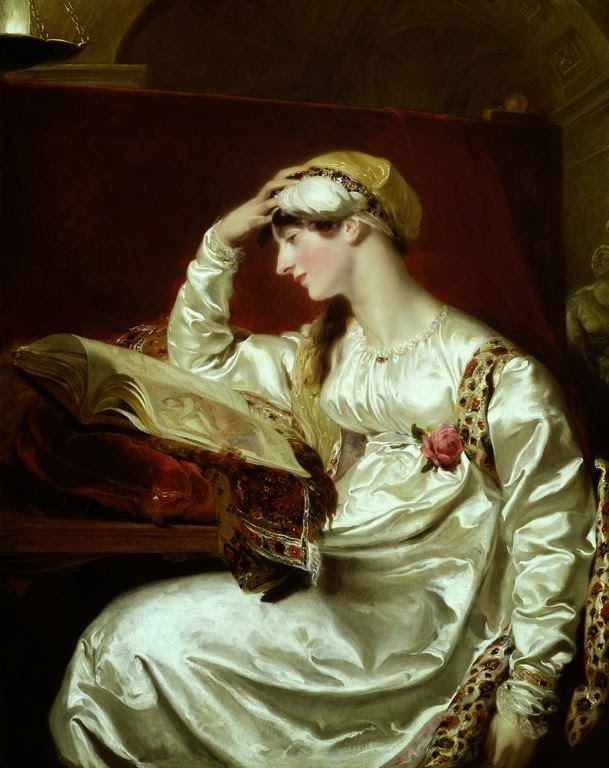
Sir Thomas Lawrence. Mrs. Jens Wolff, 1803 - 1815.
© The Art Institute of Chicago, Mr. and Mrs. W. W. Kimball
Collection.
We feed on the human drama; it stirs and nourishes us. The painting suddenly looks better. We must forget....
Monday, 7 October 2013
"The next Keats can only be a painter”
part three of The Character of Light
JOHN KEATS AND VICTORIAN PAINTERS

Edward Burne- Jones, Beguiling of Merlin, 1872 -77, Lady Lever Art Gallery.
Image source: Wikipedia
"La Belle Dame sans merci/Hath thee in thrall!"
Their admiration for his technique of conveying intensity of sensory experience was genuine - "the next Keats can only be a painter" observed Dante Gabriel Rossetti in a letter to William Morris - but like many apostles they distorted the intentions of their prophet.
Keats had.....
Sunday, 29 September 2013
the poet on the chain of art
part two of
The Character of Light
The Character of Light

"Misshapen monuments and maim'd antiques"
Byron, satirizing English Bards and Scotch Reviewers for gushing over the Elgin Marbles
He never wanted to be part of a school or movement. He saw himself as a student of life and art, not a precocious genius: “I cannot speak/ Definitively on these mighty things” he admitted in his Sonnet to Haydon after his first sight of the Elgin Marbles. When he wrote in a letter,“I never can feel certain of any truth but from a clear perception of its Beauty”, he was thinking the same as John Constable, who said“There is nothing ugly; I never saw an ugly thing in my life: for let the form of an object be what it may, – light, shade, and perspective will always make it beautiful.”

Constable, View in a Garden with a red house beyond, ca.1821, oil on canvas.
Copyright © Victoria and Albert Museum
Keats, like Constable, was not a mannerist artist, excluding or romanticising ugly realities; he was trying........
Sunday, 22 September 2013
synapse
for Catherine and DvP
The first thing you notice is the astonishing blue. It is a woman’s dress, with a luminous life of its own, a bright heart bursting out of a pale pink shell, made of the same colours as the blue sky, flushed pale carmine by the setting sun. Darkling, she “cannot see what flowers are at her feet, /Nor what soft incense hangs upon the boughs”. She has a woman’s head, but her body looks more like an exotic blue flower, a lady elf transforming from gordian to woman’s shape. Her dark curling hair might be part of a tree’s foliage.
Lady Bate-Dudley, oil on canvas c.1787. © Tate.
Her husband, Sir Henry, known as the Fighting Parson, was a loyal
friend and supporter of Gainsborough; he also wrote comic operas. The
Bate-Dudleys inhabited a surprisingly passionate landscape in their own lives.
Viewed as late 18th century society portraiture, Gainsborough’s painting of Lady Bate-Dudley is disconcerting, being far more about abstract colour and light than the status of the sitter; as poetry of art, it perfectly evokes states of mind painted in words by Keats.
Gainsborough was a poetic painter, Keats the most painterly of poets in an age inspired by unbounded imaginative affinities. Keats’ liquid imagery was as often in danger.....
Wednesday, 18 September 2013
beyond the grave:
celebrity apotheosis
"Such is the power of novelty in England, that the newspapers next morning were full of the arrival of the foreign Beauty."
François-René de Chateaubriand, describing Madame Récamier's visit to London in 1802, in his autobiography,
Mémoires d'Outre-tombe, 1839
Mémoires d'Outre-tombe, 1839

Stipple engraving by Anthony Cardon, published by Francesco Bartolozzi, of Richard Cosway's portrait of Madame Récamier
THE LAUREL TROPHY part one
THE LAUREL TROPHY part one
She was twenty-four years old and the most famous social networker in Europe. At her first public appearance in London society, "she was swept to her carriage by the tide of people....The crowd followed hard on the fair foreigner’s heels. This phenomenon
was repeated every time she showed herself in public; the newspapers
resounded with her name, and her portrait, engraved by Bartolozzi, was
distributed throughout England." (Chateaubriand, Mémoires)
Juliette Récamier's personal qualities, and fashion sense, reacted uniquely with the cultural principles and fantasies of her time, which promoted the cult of the individual. Like Napoleon, she was born out of 18th century enlightenment and revolution, a gentler kind of opportunist who seized her moment, by collaborating on the creation of an image of femininity that Hollywood, fashion and pop music industries still mimic, a self-made goddess who dictated limits to her exploitation. She is one of the few women who attempted self-determination in popular and high culture and....
Juliette Récamier's personal qualities, and fashion sense, reacted uniquely with the cultural principles and fantasies of her time, which promoted the cult of the individual. Like Napoleon, she was born out of 18th century enlightenment and revolution, a gentler kind of opportunist who seized her moment, by collaborating on the creation of an image of femininity that Hollywood, fashion and pop music industries still mimic, a self-made goddess who dictated limits to her exploitation. She is one of the few women who attempted self-determination in popular and high culture and....
Sunday, 1 September 2013

Tuesday, 27 August 2013
The rescue
With a fearful symmetry, Bubonic Plague is back where it started, in the mountains of Kyrgyzstan, reminding humans, just as the Icelandic volcano did a few years ago, that for all our big ideas and vainglory, we are puny and ineffectual, mere blaggers in the universe.
One of my favourite pictures from childhood, along with illustrations to E. Nesbit, and Tolkein, and Narnia, was from a 1930s children's history book that edified impressionable young minds in the days of Empire. Along with When did you last see your father, and Millais' two beautiful doomed boys, the Princes in the Tower (the elder, staring out from the darkness of captivity on the page with poetic prescience, his blond curls tumbling over his black velvet suit, was destined to be my husband, I knew in my eight-year old heart), my imagination was fired by a naked young girl's rescue from the window of an elegant Restoration mansion during the Great Plague of London.

Now the picture horrifies me more than the pestilence itself, a sickly Victorian excess of sentimental romanticization and sublimated paedophilia, the imagery of soft porn applied to social and medical history.
Before we pass sentence on our 19th century ancestors for lapping up this sort of mass-marketed fantasy, born out of the conviction that humans are the progressive conquerors of evil, and that the best way to secure ourselves against the return of a powerful enemy is by trivializing it, we should remember our own smugness, our own self-deluded race away from reality, our odd taste for sensationalism and tweeted voyeurism, our ambition to live longer and longer while poverty and inequality and cruelty and conceit infect the world.
Who cares, so long as we can share a photo.
One of my favourite pictures from childhood, along with illustrations to E. Nesbit, and Tolkein, and Narnia, was from a 1930s children's history book that edified impressionable young minds in the days of Empire. Along with When did you last see your father, and Millais' two beautiful doomed boys, the Princes in the Tower (the elder, staring out from the darkness of captivity on the page with poetic prescience, his blond curls tumbling over his black velvet suit, was destined to be my husband, I knew in my eight-year old heart), my imagination was fired by a naked young girl's rescue from the window of an elegant Restoration mansion during the Great Plague of London.

Now the picture horrifies me more than the pestilence itself, a sickly Victorian excess of sentimental romanticization and sublimated paedophilia, the imagery of soft porn applied to social and medical history.
Before we pass sentence on our 19th century ancestors for lapping up this sort of mass-marketed fantasy, born out of the conviction that humans are the progressive conquerors of evil, and that the best way to secure ourselves against the return of a powerful enemy is by trivializing it, we should remember our own smugness, our own self-deluded race away from reality, our odd taste for sensationalism and tweeted voyeurism, our ambition to live longer and longer while poverty and inequality and cruelty and conceit infect the world.
Who cares, so long as we can share a photo.
Thursday, 8 August 2013
Among Tigers and Panthers
“Perhaps in the next world women will be more valued than they are in this.”
SARAH SIDDONS by Lawrence

Portrait by Thomas Lawrence; Tate Gallery, London. Photo: Tate, London 2011
The Tragic Muse of Neoclassicism and prophetess of Romanticism in a portrait of 1804, when she was nearing fifty, in which her lifelong friend, Sir Thomas Lawrence (1769 -1830), displayed her powerful physique and brooding presence with such panache that she looks like a bruiser about to step forward and knock you out....
The Tragic Muse of Neoclassicism and prophetess of Romanticism in a portrait of 1804, when she was nearing fifty, in which her lifelong friend, Sir Thomas Lawrence (1769 -1830), displayed her powerful physique and brooding presence with such panache that she looks like a bruiser about to step forward and knock you out....
Sunday, 4 August 2013
Romantic fictions and casualties
“I never should have sung as I do had I never seen you; I never should have composed at all. . . You then liv'd in my heart, in my head, in every idea…”


The Art of Loving or The Pleasant Lesson, furnishing fabric,
Favre Petitpierre et Cie (possibly, maker), ca.1785-1790, detail © Victoria and Albert Museum, London
PART ONE
One autumn long ago, while
Britain was at war with revolutionary France, and was rejoicing at the Royal Navy’s victory under Nelson at the Battle
of the Nile, which thwarted Napoleon's ambitions to conquer the Middle East as he had done mainland Europe, and Irish rebels with French help
were fighting their English oppressors, when Jenner had recently
published his findings on small-pox vaccination, while a new poetry in Lyrical Ballads was being read for the
first time, and a new kind of woman had appeared
in a novel by Mary Wollstonecraft called Maria:
or, The Wrongs of Woman, the eldest daughter of the Tragic Muse renounced forever the man she loved.
He was a charming young artist who painted everyone as if he was in love with them. His pencil, chalk and brush had the power of Cupid's arrows to pierce men and women with the flushed, breathless heat of desire. When he looked at someone, however dull they had felt the moment before, they saw the reflection of beauty in his eyes.
He was....
Sunday, 21 July 2013
The Gathering in a Park

Watteau: L'Assemblée dans un parc, oil on wood, 1716-17, Musée du Louvre.
Image source: WGA
 | ||
| detail of Caspar David Friedrich's Chalk Cliffs on Ruegen |
Monday, 1 July 2013
known unknowns
Part Seven of Among Tigers and Panthers
"MARIE-DENISE VILLERS"
by herself
 |
| OWNING HER IDENTITY: Young Woman Drawing, oil on canvas, 1801. Metropolitan Museum of Art, New York |
Art historians now usually attribute this painting to Marie-Denise Villers (1774-1821) and, gratifying our cut-and-dried need for names and labels, believe that it is a self-portrait. The sitter's identification, and whether she is sketching us or herself, does not detract from the imaginative suggestiveness of the picture, or of the picture within the picture, framed by the window pane, or of the unclouded certainty in her gaze. We are not really sure about anything, though we like to think power has been transferred from artist to spectator, and we are compelled to pontificate, blah and blog. But this half-forgotten painting defeats us. Knowledge belongs to the artist/model; she holds the source of reflected light illuminating her own face; through the image she has selected to show us, she is in control of her story....
Saturday, 15 June 2013


Wednesday, 5 June 2013
My friend Sarah Vernon 1957 - 2021
While I was sitting in the dappled sunshine of the dying planet, reading my friend Sarah's blog, two women coming from different directions met in my mind's eye. They did not look or behave alike, but I saw them make a connection without a social networking site.
Madame de Staël was loud and unrestrained, emotionally and sexually; her stormy moods drove away her unfaithful lover, misnamed Constant;
my friend Sarah is always self-controlled and elegant in everything she does.Though they both love hats, I've not yet seen Sarah in a bright silk turban like Madame de Staël's.

François Gérard or, more likely from the style and background,
Anne-Louis Girodet de Roucy Trioson.
Image source: Wikipedia
The thing that struck me just now, seeing them walking in the light, shining from the clarity of their intellects, their gift for friendship, their instinctive love of art and literature, their indefatigable courage and resourcefulness, is the knack they have of combining all this into a radiant whole, shedding light over the rest of us.
They are instigators and inspirers and sharers. De Staël, a shrewd self-publicist who knew how to market her flamboyant personality, would have been blogging and tweeting if the technology had been at her disposal. If Sarah had lived in the early nineteenth century, and had Germaine's money and connections, she would have held a brilliant salon at her continental waterside retreat, presiding and encouraging others with wry wit and wisdom, discerning truth, laughing at folly, and founded and edited a cultural journal. She would have published novels and literary and theatre criticism; she would have decorated her home with original artworks, and she would have been a majestic actress, renowned for her beautiful voice, deep and rich, complex as fragrance notes.
So here's to all the modern salonnières.
Sarah, this was for you.
Germaine de Staël is very well known, and easy to find:
 |
| Madame de Staël's chateau at Coppet on Lake Geneva |
If you want to know Sarah better, look here.
My friend Sarah Vernon 1957 - 2021
Subscribe to:
Posts (Atom)