Showing posts with label Theatre. Show all posts

Sunday, 29 July 2018

"Darling! The set was wonderful"

It’s one of those site-specific shows in which the lead actress, in the title role of “Sweet Melancholy”, is upstaged by a live, cooing, flying prop; the play is in blank verse, and the director, after blaming everyone else at the Tech Rehearsal, has lost the plot; but the set design is wonderful....

 Joseph-Marie Vien Sweet Melancholy 1756.
Cleveland Museum of Art. Image: Wikipedia

Melancholy, as you know it, was never this sweet. This looks more like Wistful Posing, though maybe you have missed the point about contemporary self-consciousness. Mid-drama, she, Melancholy, looking as pretty as possible, rearranges her drapery and takes a selfie.

You would be at a loss for words when you congratulate your friend afterwards, if it wasn't for Vien's sophisticated colour scheme, daring to put Melancholy's acid yellow dress against a dark grey background, and his dedication to historical detail in the props and furniture, pioneering a fashion in neoclassical home interiors.

The smoke from the antique brazier is scented, sending the front rows, especially the critics, into drowsy raptures. That might explain the liminal moment when you thought you heard the dove speak.

You travelled far to get here, to a disused temple in an inaccessible part of the old City, where no buses dare to stop. You took three wrong turns on your way from the station. You are dismayed by the thought of missing connections on the long journey home, and arriving tired and dispirited in the lonely night.

You imagine yourself slumped unprettily on a chair, holding your head in your hands, mourning your losses, knowing that bad as the day has been, there is always hope tomorrow will be worse.

You promise yourself that if you can ever afford it - ach, if only you'd got that film job the other day - you will buy a neoclassical upholstered chair and incense-burner, and recline elegantly in a full-length, yellow silk gown, to sweeten your own melancholy.

You are not lying when you reassure Sweet Melancholy that, "You looked like a goddess on that set, and deserve awards just for acting with that pigeon."

Wednesday, 11 April 2018

What, in our house?

https://pipparathborne.wordpress.com/2018/04/11/what-in-our-house/

BRITAIN IS A HOSTILE ENVIRONMENT,
IN DENIAL


Something has gone very wrong in our country, and like a terminally ill person in denial of their mortality, about half the British public aren’t admitting it. Such things don’t happen in Britain, they believe. It’s only other nations that commit atrocities, build concentration camps, persecute innocent people. “It wouldn’t happen here”. 

It is happening here.

“What, in our house?” enquired Lady Macbeth, on hearing of the murder of King Duncan, which she had just instigated.,,,Read full post

Monday, 22 December 2014

In this world and the next: a tragedy of gender and celebrity

“Perhaps in the next world women will be more valued than they are in this.”
SARAH SIDDONS (1755 - 1831)


Self-portrait by Sarah Siddons, plaster bust c 1820 © Victoria and Albert Museum

PART FOUR - A Woman's Tragedy continued

Sarah Siddons had to bear the worst tragedy that can befall a mother, the death of a child, five times. Two of them died in infancy, an expected mortality rate for the time, but she gave the impression that only pouring her grief into acting enabled her to endure the losses of two grown up daughters, one aged only nineteen, and of her eldest son when he was forty, all due to lung diseases. Two children, a son and a daughter, survived her.

As a conscientious mother, Mrs Siddons' instinct was to protect her daughters from the devil's profession of acting; as an actress, to protect herself from competition. She and William Siddons were anxious to secure conventional respectable lives for all their children. Only Henry, the eldest, became an actor. Their younger son, George, was a godson of the Prince of Wales, later George IV, and entered the Indian Civil Service.

In the character of a tender mother, with her son Henry Siddons, the only one of her children to follow his parents into the acting profession, in 'Isabella' by Thomas Southerne. Engraving, June 1785, London by Caldwall of a painting by William Hamilton © Victoria and Albert Museum.


Due to their mother's successful career, the girls were not brought up in expectation of having to work for a living. Mrs Siddons provided for them all their lives.


All three girls were articulate, attractive, self-assertive and strong-willed, raised in a cultured household, conversing with the leading writers, artists and actors of the day. The eldest, Sarah Martha, known to the family as Sally, was reputed to be an accomplished song-writer. Weakening health cut short any professional aspirations of the two elder girls, and the youngest was brought up from the age of nine to be her mother's companion and solace in retirement, a sacrifice made without complaint or surrender of individuality; after Mrs Siddons' death, with her comfortable inheritance, she lived an active and happy life.

Her daughters were not downtrodden; they respected their mother and her career; the highly intelligent eldest and youngest daughters were protective of her professional creative needs, which included being spared emotional upset at home. 

Like other loving mothers, the only thing Sarah Siddons, the prophetess of emotion on stage, could not save her daughters from was their own feelings. Sally never blamed her mother for the part she played in the psychological drama - it wasn't a love story - with Thomas Lawrence that overwhelmed all of them. 

Initially, Mrs Siddons was too blinded by her own affection for Lawrence to see the whirlpool into which he was pulling them; she was enjoying the undercurrent too much, that his confused feelings were flowing towards her, not her daughters.
The Gipsy Girl by Thomas Lawrence, oil on canvas, 1794
© Royal Academy of Arts, London
A disturbing piece of erotica by Lawrence, for which Maria Siddons, aged fifteen, has been suggested as the model. It is a plausible theory: she has the intense, dark eyed and tousle-headed look of her family, and the date fits with their period of intimacy. The genre to which the picture belongs in art history is "fancy", a sentimental objectification of rural life for rich people, but this wild, half-naked, boyish girl with her flushed cheeks, parted lips and fierce gaze, is inviting a far more sexually ambivalent response, begging tough questions about what on earth Lawrence wanted out of the Siddons sisters.

Mrs Siddons was in her early forties, still slim and splendidly handsome, at an age when the most famous actress in the country needed assurance that she could still be loved as a woman, not just a national monument. It was never a sexually consummated love affair; it was more of a self-dramatization for the suppressed bisexual, celebrity-obsessed Lawrence to fulfill an impossible dream of union with the irreproachably moral mother-goddess Mrs Siddons.

Sarah Siddons and members of her family by Richard James Lane, published by Joseph Dickinson, after Sir Thomas Lawrence, lithograph, published May 1830
© National Portrait Gallery, London. 
Sketching her informally at home in 1798, at the time he was trying to marry one of her daughters, Lawrence saw the actress as a classical deity of brooding potency with three of her children and one of her younger brothers revolving like satellites around her. Clockwise: Cecilia Combe (née Siddons); Sarah Siddons (née Kemble); Maria Siddons; George John Siddons; Charles Kemble (actor)


Lawrence was fourteen years younger than Mrs Siddons and ten years older than her daughter Maria, who was a lusciously pretty sixteen year old when he started courting her after ditching the elder sister. Both girls shared the intense dark-eyed good looks and striking features of their mother; they were mini-Sarah Siddonses. 

A generational pattern was being repeated: Sarah Kemble had been a headstrong fifteen year old when she promised herself to William Siddons, an actor eleven years older than her in her father's touring company. Roger Kemble was so disapproving that he dismissed his daughter, despite her obvious talent, and sent her into service, to no avail, because the determined lovers married two years later.

Mrs Siddons supported what she believed was true love, joining Lawrence and Maria's fight to overcome William Siddons' opposition to an engagement until they wore him down. He looks tired in Opie's portrait. A few weeks after pledging his troth to Maria, Lawrence broke the news to Mrs Siddons that he had changed his mind again, and wanted to marry her elder daughter. She was sympathetic; she understood the play of passions in an artistic temperament. A few months after that, Maria was dead.

Lawrence was the only other man apart from her husband who aroused such reckless feelings in her; he was a soulmate, and they had a rapport that was never broken, even after Maria and Sally's deaths; in old age, she said she wanted Lawrence to be a pallbearer at her funeral. They were part of each other's myth.


It says a lot about the devotion and respect that Sarah Siddons commanded from people, and even more about the steadfast character of her eldest daughter, that Sally did not utter or write a word of reproach against the mother she adored.

Money was important to Mrs Siddons, as it was to a self-made man like Lawrence. Contemporaries, wanting artists to live on inspiration alone, sneered at their materialism. Formative experiences had made both of them terrified of penury. She was understandably jealous of her value in a male-dominated market. Her notorious meanness about appearing for other actors’ benefits is contradicted by the numerous charity performances she gave after her official retirement, not always for members of her own family. Her celebrity and relative affluence for a self-employed actress made her a target for caricaturists, and, finding no other vices in her, they aimed at her supposed avarice.


 Print by Gillray, Theatrical Mendicants, relieved, published 1809. Sarah Siddons and her brothers Charles Kemble and John Philip Kemble begging for money to rebuild Covent Garden Theatre. Mrs Siddons appears as a more forceful masculine presence than her fawning brothers; even in caricature, she retains dignity © Victoria and Albert Museum.

In 1789, during a brief break from acting, due to ill-health, she took up sculpture as an alternative creative outlet which sustained her through emotional crises and later her melancholy retirement. Her main subject was herself.  She discovered an even more powerful intensity than any of the many artists who portrayed her, a fuller underlip jutting forward in an expression seething with passions, a Shakespearean head of Brutus, a brooding Romantic hero, a grieving mother or queen, a guilty Lady Macbeth reliving her crimes in her sleep. She could imagine herself in all these parts.

The esteem in which Mrs Siddons was held by the public and critics was higher than that of any other actor, male or female, but her brother John Philip Kemble was given grander honours on his official retirement than she had on hers. Stung by this proof of the difference in the official status of male and female actors, Mrs Siddons remarked that "perhaps in the next world women will be more valued than they are in this”.


siddons2
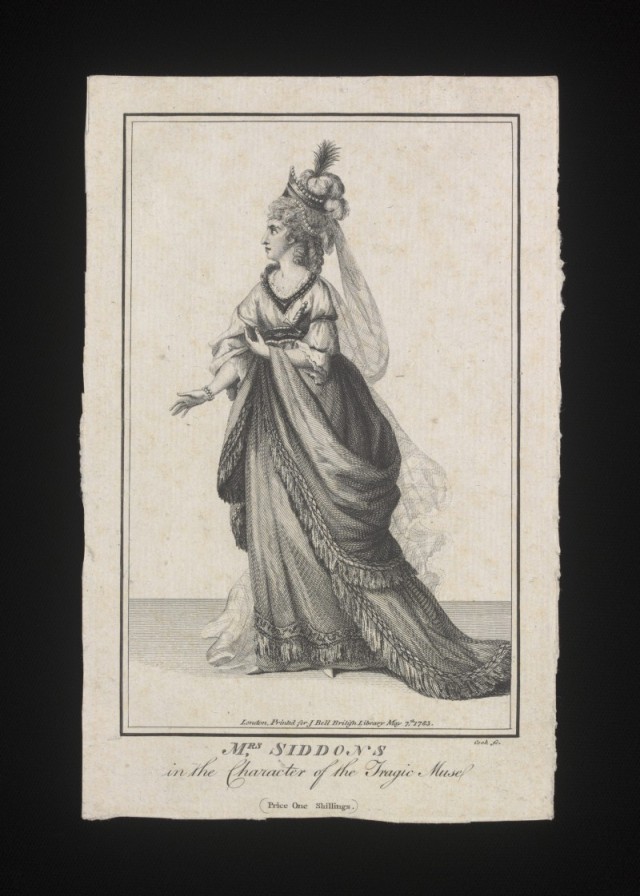
 Mrs Siddons in the Character of the Tragic Muse engraved by Cook, 1783. © Victoria and Albert Museum. She walks regally into the next world, as the most famous tragedienne in English-speaking history

Wednesday, 17 December 2014

In this world and the next

“Perhaps in the next world women will be more valued than they are in this.” SARAH SIDDONS (1755 - 1831)
PART THREE: An obvious conclusion
 Sarah Siddons as Zara in Congreve's tragedy 'The Mourning Bride', engraving by after painting by Thomas Lawrence, 1783. Image © Victoria and Albert Museum. This is the face of a determined, passionate, brave, intelligent individual, transcending gender. "Independence I will ever secure..." Mary Wollstonecraft.
"...she did look so beautiful! It is a part I like to see her act extremely." Sally Siddons, writing in a letter on February 8th, 1799, about her mother as Zara. 

Sarah Siddons was socially acquainted with Mary Wollstonecraft and only four years older. Temperamentally, the reserved actress, who regulated her emotions and the impulsive, radical feminist, who acted on her desires, were far apart. Siddons did not see herself as a rebel other than in being an actor, which, in the glory days, before it was confused with showing-off, was a form of rebellion in itself.

She craved social acceptance, for herself and her children. She was more interested in improving her life through her art than suffering for it. In private, this passionate artist was conventional, religious and moral. She never compromised her right to have a career, children and a husband, and she earned it all herself.


Frequently when Wollstonecraft wrote about an emancipated woman, independent of men and men's money, she unintentionally described Siddons: “It is time to effect a revolution in female manners - time to restore to them their lost dignity - and make them, as a part of the human species, labour by reforming themselves to reform the world. It is time to separate unchangeable morals from local manners.”


“Independence I have long considered as the grand blessing of life, the basis of every virtue; and independence I will ever secure by contracting my wants, though I were to live on a barren heath.”  Mary Wollstonecraft wrote the words; you can hear Sarah Siddons saying them.

Tuesday, 2 December 2014

In this world and the next:a tragedy of gender and celebrity

“Perhaps in the next world women will be more valued than they are in this.”
SARAH SIDDONS (1755 - 1831)

PART ONE - A Celebrity's Tragedy
2006AV2988 
Sarah Siddons, oil on canvas c 1784, attributed to William Hamilton (or Thomas Beech).
© Victoria and Albert Museum.

Siddons dominated the female tragic roles on the English stage for over 30 years. Her stately performances in the most emotionally immediate of art forms articulated the eighteenth century's ideal of the sublime, and her representations of the classical passions, in combination with her outwardly virtuous private life, won over audiences as diverse as George III, who appointed her Reader to his family, and Lord Byron, who admired her more than any other actor, male or female, worth more than Cooke, Kemble and Kean all put together. Even the Duke of Wellington, as famous for dry understatement as she was for grand pathos, was a fan.

Going to see her act was like an ecumenical religious event. Hazlitt said she was a goddess, Tragedy personified. By the time she died in 1831, she had outlived two kings, her friend, the portraitist Lawrence, the poet Byron, her brother and fellow-actor John Philip Kemble, her upstaged and discarded husband William Siddons, and, worse than anything that a mother should endure, five of their children, but not her reputation.

The mystique of the Tragic Muse had been preserved, but only just. Even before her formal retirement in 1812, something had gone wrong. "She was no longer the same...." complained Hazlitt of her inaudibility and disproportionate emphases. She kept making ill-advised and distressing comebacks: "her voice appeared to have lost its brilliancy"; "....she laboured her delivery most anxiously as if she feared her power of expression was gone" (Robinson).

She had gone from goddess to joke.

Saturday, 22 November 2014

Out of the killing sun

PART FIVE OF ROMANTIC FICTIONS AND CASUALTIES

 Adam Buck, Two Sisters, print, 1796. London.
© Victoria and Albert Museum, London
Sense and sensibility, reason and passion, love and illusion, neoclassicism and romanticism dancing on the eve of cataclysm.
During the years 1795 to 1797, while the two elder Siddons sisters were engaged in their own danse macabre with Thomas Lawrence, Jane Austen wrote her first draft of the novel that was eventually published in 1811 as Sense and Sensibility.

It should have been the end, the two beautiful girls consumed by passion and disease, but the Tragic Muse had another daughter, only nine years old when her eldest sister died, a child with a name like the peal of golden bells under a blue sky, a tiny Buddha with a ferocious will [1] and eyes that glared like a torch in the night on the charades and vacillations of grown ups. 

After Sir Thomas Lawrence, Cecilia Combe, (née Siddons), 1798. Lithograph by Richard James Lane, printed by Charles Joseph Hullmandel, published by Joseph Dickinson,
May 1830. © National Portrait Gallery, London. She glares out of the picture
with fanatical fervour, lowering her brows like her mother did in dramatic parts.

Her resemblance to the second of her elder sisters was so close in "all the dazzling, frightful sort of beauty that irradiated the countenance of Maria" [2] that she made the Tragic Muse shudder.

She was designated the last companion of the goddess, the comfort of her melancholy age, and custodian of her shrine. For twenty-eight years the purpose of her existence was to serve her mother, who stared back at her with vacant eyes, in "apparent deadness and indifference to everything". [3]

But the youngest daughter had a flame inside her that would not be quenched.  She had a gift denied her sisters. She did not breathe the same fatal air as they had done. She outlived her mother to write her own last act. She was determined that it would be not be a tragic one.

Her sisters' ghosts haunted her girlhood, her memory of them based more on other people’s accounts than her own recollections; they were cautionary figures from myth, glimpsed in faded portraits and drawings, girls who should have been entwined in their youthful loveliness, but were sundered by bitterness, wraiths straying in the seductive heat of their mother's and an artist's imaginations, to fall and drown in the pool of Narcissus.

In 1798, the two elder daughters of the Tragic Muse had pursued love to give them individual identity in a revolutionary world that seemed to offer a new dawn to men and women. They had hoped, like the two young step-sisters who wnent on an adventure of free love with Shelley and Byron in the lakes and mountains of Europe sixteen years later, to find "an immortality of passion."[4]

Tuesday, 18 November 2014

Romantic Fictions and Casualties

Part Four:
The Prophetess and the Muse

Shortly after the death of the eldest daughter of The Tragic Muse, whom he had once thought he loved, in the same year of 1803, the artist found his ideal of physical and intellectual femininity personified in an elegant and composed woman, a refined and independent spirit who understood his temperament and his art. She was about the same age as the daughter of tragedy, perhaps a few years older, tall and dark like her, but uncomplicated by illness and sisters.

She was a model of discretion as much as beauty, a social sophisticate who made no demands on him. She did not need marriage to consummate their friendship so not a breath of scandal marred the artist's reputation ever again. Her gratification came from inspiring and guiding him to create works that would invest her with immortality by association. She was his perfect muse.

The shining culmination of the artist's love of his muse:
Sir Thomas Lawrence. Mrs. Jens Wolff, 1803 - 1815. 
© The Art Institute of Chicago, Mr. and Mrs. W. W. Kimball Collection.
At the time she first met Lawrence, Isabella Anne Hutchinson was unhappily married to the Danish diplomat and art collector Jens Wolff from whom she later separated in 1810.

He spent twelve years painting her portrait, and it was the most emotionally tender image of a woman he ever created.

The éclat of her splendid aquiline profile, gracefully bent in contemplation of Michelangelo's drawings, recalled the artlessly drooping head of the dead girl he had tried to love, listening to her own thoughts, composing her own songs. If he had been a woman, this was how he would like to have been painted, and loved.


The Tragic Muse carried on working for a few more years after her eldest daughter's death, but she had lost some of her elemental power. The people no longer worshipped as before. They demanded to see her in the same parts, then criticized her for using “her great guns” too soon, never caring that the goddess in person really was "in paroxysms of agony".[1]

Her presence had always been monumental, but now her body had grown so heavy that could not get up without help during performances. People felt sorrier for the woman herself than the characters she was playing.

William Blake,Hecate or the Three Fates c. 1795. Tate Gallery, London. 
Image source: WGA

Despite her habit of standing outside herself, so she could control the effect she was making, mortality had overrun her divine gift. Either her own emotions had burst their banks and flooded the character she was imagining, or public taste in deities was changing....

Friday, 14 November 2014

Romantic fictions and casualties

PART THREE: SILENCE

 Silence by Fuseli, 1799-1801
Oil on canvas, Kunsthaus, Zurich. Image source: WGA

The lightning struck, and receded, the earth quaked and settled again. Resolute, she never spoke again of love and betrayal. She began to believe that the artist had never loved her for her own sake, but more for the sensation of passion, a drama of love, in which she and her sister had been no more to him than sparks of her mother's fire. She knew her mother and he still met, an ageing goddess and her acolyte, and she did not say a word of reproach to either of them.

But the worm had entered the bud. During the next five years, while his fame as an artist and a lover spread, and queens and princes were seduced by him, and still he wore his sweet-sad smile, she started to wither away until her own muse fled - “I sing but little now to what I did once”. She had lived only to give joy to those she loved, and she had no joy left. She had reached the limits of feeling. She lived, but it was the posthumous existence of despair.
Every asthma attack was like a drowning, in which to die would be easier than the struggle for breath. She yielded to invalidism as if it was a lover. 

She never lost faith in her mother, she would always be the chief priestess of the Tragic Muse, ensuring nothing distracted the goddess, knowing that the slightest shift of wind might upset the sacred artifice of her art, causing the goddess to misjudge her timing or overreach her power to represent emotion from feeling too much, performing worst when she most ardently wished to do better than ever.[1]

Her breath got shorter and shorter. Even when she knew she was dying, the eldest daughter did not want to cause her mother trouble. There was never any question that the goddess must continue working while her daughter was ill, often travelling far away, giving spiritual sustenance to her worshippers on other islands to pay for medicine, food, clothing and lodgings for her family.  All her life the girl had suffered in her mother's absence which created a vacancy in her heart that nothing else could fill [2] but she and her father, a mere mortal player, not a god, who relied on his wife's earnings to maintain their household, kept the worst news to themselves.


Drawing of Sarah Siddons, artist and date unknown  © Victoria and Albert Museum 
 

At last there came a day when an attendant dared tell the Tragic Muse that her daughter was dying. "Will you believe I must play tonight!" [3] exclaimed the distraught mother. She had always known that she was not immortal, as people wanted her to be, but rather an heroic victim of her own powers of arousing emotion. She broke her contract so she could rush home, but her journey across the sea was delayed by great storms, which neither her dramatic arts nor maternal appeals could appease, and when she arrived, her lovely child, her sweet Sally, was already dead.


Claude-Joseph Vernet, Nocturnal Seastorm 1752
Oil on canvas. Private collection. Image source WGA


[1] Paraphrasing Sarah Siddons' much quoted piece of self-criticism that holds true for all actors, from her letter to Rev. Whalley, 16 July, 1781, published in The Kembles, Percy Fitzgerald, 1871: "Sorry am I to say, that I have often observed I have performed worst when I have most ardently wished to do better than ever"[2] Paraphrasing Letter from Sally Siddons to Miss Bird, 15 September, 1798, quoted by F.M.W. Parsons, The Incomparable Siddons, 1909, p.199.
[3] Paraphrasing Letter from Mrs Siddons to Mrs Fitzhugh, quoted by Parsons, p.204

Saturday, 8 November 2014

Romantic fictions and casualties

PART TWO: The temple of delight

 
Fragonard, The Fountain of Love 1785. Oil on canvas, Wallace Collection, London.
Image source: WGA. In this painting, the purveyor of insouciance and erotica for the ancien regime breaks into the psychological dreamworld of the Neoclassicists and Romantics.
"I fly with HORROR from such a passion" Sally Siddons

The Tragic Muse's eldest daughter had loved the artist steadfastly even after he had forsaken her for her younger sister, a pretty, airheaded girl of sixteen he decided, on an impulse, to marry. 

During this gaping wound in time, her two years of "mortification, grief, agony", a new kindling began inside her. Under layers of suffering, she heard more clearly the music of her calling. 

Passion reverberated in her, enriching her voice with sweetness, her melodies with mortal yearning: “I never should have sung as I do had I never seen you; I never should have composed at all. . . You then liv'd in my heart, in my head, in every idea…”. 

She had turned a fallible man into her muse, and given birth to her own art.

Saturday, 1 November 2014

Romantic fictions and casualties

“I never should have sung as I do had I never seen you; I never should have composed at all. . . You then liv'd in my heart, in my head, in every idea…” 

 
The Art of Loving or The Pleasant Lesson, furnishing fabric,
Favre Petitpierre et Cie (possibly, maker), ca.1785-1790, detail © Victoria and Albert Museum, London

PART ONE
One autumn long ago, while Britain was at war with revolutionary France, whose armies under Napoleon had conquered most of mainland Europe, and the people at home were rejoicing at Nelson's victory at the Battle of the Nile that saved the Middle East, while Irish rebels were fighting their English oppressors with the help of the French; while Jenner's findings on vaccination against the mass killer small-pox were being published; while a new kind of poetry was being read for the first time in Coleridge and Wordsworth's collection of Lyrical Ballads, while quietly in a village in Hampshire Jane Austen was writing Northanger Abbey, and a new kind of woman appeared in a novel called Maria: or, The Wrongs of Woman by Mary Wollstonecraft; while the external world was spinning and bleeding and crying and laughing, the eldest daughter of the Tragic Muse renounced forever the man she loved. 

He was a charming young artist who painted everyone as if he was in love with them. His pencil, chalk and brush had the power of Cupid's arrows to pierce men and women with the flushed, breathless heat of desire. When he looked at someone, however dull they had felt the moment before, they saw the reflection of beauty in his eyes. 


François-André Vincent, Zeuxis Choosing his Models for the Image of Helen from among the Girls of Croton 1789. 
Oil on canvas. Private collection. Image source: WGA

He was....